
Workers' Compensation Verification
Post-offer workers' compensation claims history — conducted the only compliant way, at the only compliant time. Trusted since 1979.
Workers compensation verification reveals a candidate’s prior workers’ comp claims history — the claims filed, their nature, and their dates. But there’s one thing every employer must understand before ordering it: no state allows a workers’ compensation filing check before a job offer is made. This search can be conducted only after a conditional offer has been extended. DDS performs workers compensation verification the compliant way — post-offer only — protecting employers in physical-labor industries from both workplace risk and legal exposure.
Built for Physical-Labor Industries
Trusted Since 1979
What Is Workers' Compensation Verification?
Workers compensation verification is a search of a candidate’s workers’ compensation claims history. It reveals prior claims the candidate has filed — and while the specific information available varies by state, in general the report includes the claims themselves, their nature, and their dates.
For employers in physically demanding industries, this history serves a legitimate and specific purpose after a job offer has been made: understanding whether a new hire has prior injuries relevant to the physical demands of the role, supporting safe job placement, and protecting both the employee and the employer.
Used correctly, workers compensation verification is not about screening people out — it’s about placing people safely. A prior injury history may inform accommodations, role fit, or safety planning. Used incorrectly — before an offer, or as a blanket disqualifier — it creates serious legal exposure. That’s why the timing rule matters so much, and why DDS enforces it.
The Rule That Defines This Search: Post-Offer Only
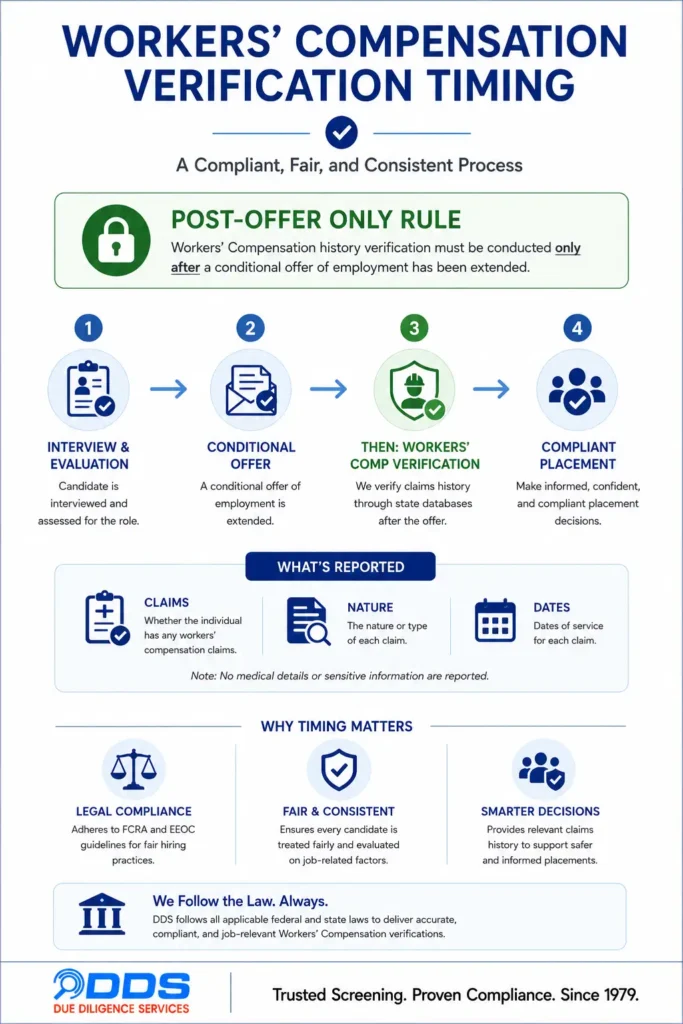
Here is the single most important fact about workers compensation verification: no state allows a workers’ compensation filing check before a job offer is made. Only after a conditional offer has been extended can this search be conducted.
This isn’t a DDS policy preference — it’s the legal landscape. The Americans with Disabilities Act (ADA) and state laws treat workers’ compensation history as medical-related information. Inquiring about it pre-offer amounts to a prohibited pre-employment medical inquiry. Post-offer, the picture changes: an employer may condition an offer on the results of appropriate post-offer inquiries, applied consistently to all entering employees in the same job category.
The practical workflow is:
1. Interview and evaluate the candidate without any workers’ comp inquiry
2. Extend a conditional job offer
3. Then — and only then — conduct the workers compensation verification
4. Apply the results consistent with ADA and state-law requirements
DDS structures the workers compensation verification process around this sequence. The search is positioned in the screening workflow where it legally belongs: after the offer, never before.
What the Report Includes
The specific information available in a workers compensation verification varies by state — each state maintains its own workers’ compensation records with its own disclosure rules. In general, the report includes:
– Claims filed — the prior workers’ compensation claims on record for the candidate
– Nature of the claims — the type of injury or condition involved
– Dates — when the claims occurred
Because state rules differ on what can be disclosed and how, DDS handles each workers compensation verification according to the requirements of the state involved — retrieving what that state makes available, in the manner that state permits. Employers receive the claims history the jurisdiction allows, delivered within the post-offer compliance framework.
Hiring for physically demanding roles?
A 20-minute consultation will show you how to add workers compensation verification to your post-offer process the compliant way — supporting safe placement without legal exposure. No obligation, no charge.
Which Industries Use Workers' Compensation Verification
Workers compensation verification is used mostly by industries where physical labor is conducted — workplaces where the physical demands of the job make injury history relevant to safe placement:
– Manufacturing — production floors, machinery operation, repetitive physical tasks
– Warehousing and Distribution — lifting, loading, material handling
– Construction — physically demanding trades with elevated injury risk
– Transportation and Logistics — driving, loading, physical freight handling
– Skilled Trades — physically intensive trade work
For these employers, the post-offer workers compensation verification supports informed, safe job placement: matching new hires to roles their history supports, planning accommodations where appropriate, and protecting everyone on the floor. For office roles without physical demands, this search generally isn’t relevant — and DDS will say so rather than sell an unnecessary search.
Why Employers Choose DDS for Workers' Compensation Verification
1. Compliance-first timing. DDS conducts workers compensation verification post-offer only — the only compliant way — and structures the workflow so the search happens where it legally belongs.
2. State-by-state handling. Each state’s records and disclosure rules differ; DDS retrieves what each jurisdiction makes available, the way that jurisdiction permits.
3. Claims, nature, and dates. The report delivers the claims history the state allows — the information employers need for safe placement decisions.
4. Safe-placement framing. DDS positions this search as a placement and safety tool, not a disqualification shortcut — consistent with ADA requirements.
5. Honest role-relevance guidance. DDS recommends this search for physical-labor roles where it genuinely applies — not as a blanket add-on.
6. Operating since 1979. Decades of experience conducting sensitive, regulated searches within the compliance lines.
Frequently Asked Questions
What is workers' compensation verification?
Workers compensation verification is a search of a candidate’s workers’ compensation claims history. While the specific information varies by state, the report generally includes the claims filed, their nature, and their dates. It’s used by employers in physically demanding industries to support safe, informed job placement after a conditional offer.
Can I run a workers' comp check before making a job offer?
No. No state allows a workers’ compensation filing check before a job offer is made. Only after a conditional offer has been extended can this search be conducted. Pre-offer inquiries into workers’ comp history amount to prohibited pre-employment medical inquiries under the ADA. DDS conducts this search post-offer only.
Why is this search post-offer only?
The Americans with Disabilities Act and state laws treat workers’ compensation history as medical-related information, and pre-offer medical inquiries are prohibited. Post-offer, an employer may condition the offer on appropriate inquiries applied consistently to all entering employees in the same job category. The timing is the compliance line.
Why Employers Choose DDS for Employment Verification
What does the report show?
In general: the claims filed, the nature of each claim, and the dates. The specific information available varies by state, since each state maintains its own workers’ compensation records with its own disclosure rules. DDS retrieves what each state makes available, the way that state permits.
Which industries should use workers' compensation verification?
Mostly industries where physical labor is conducted — manufacturing, warehousing and distribution, construction, transportation and logistics, and skilled trades. For roles without physical demands, the search generally isn’t relevant, and DDS will advise accordingly.
Can I withdraw an offer based on workers' comp history?
Only within strict ADA and state-law limits. Employment decisions based on workers’ comp history must be job-related and consistent with business necessity — for example, a genuine inability to perform essential job functions even with reasonable accommodation. Blanket disqualification based on claims history creates serious legal exposure. This is an area where consulting employment counsel is advisable.
Is workers' compensation verification part of a standard background check?
No — because of its post-offer timing requirement, it sits separately from the pre-offer components of a background check. DDS positions the workers compensation verification in the post-offer stage of the screening workflow, after the conditional offer, alongside any other post-offer components.
Why Employers Choose DDS for Employment Verification
How does DDS keep this search compliant?
By enforcing the post-offer timing, handling each state’s records according to that state’s rules, framing the search as a safe-placement tool consistent with the ADA, and applying the same compliance review DDS gives every report before delivery.
Add Post-Offer Screening the Compliant Way
A free consultation shows you how workers compensation verification fits your post-offer process — claims history for safe placement, handled within the compliance lines. No obligation, no charge.