
Sex Offender Registry Search
National and all 50 state sex offender registries — with every match verified through cross-referenced data before it reaches your report. Trusted since 1979.
A sex offender registry search protects the people your organization serves — especially in environments involving children, the elderly, patients, and other vulnerable populations. DDS performs a comprehensive sex offender registry search covering the national registry and all 50 state registries, and every potential match is verified through cross-referenced personal data before it appears on a report. The result is thorough coverage without the false positives that careless registry searches produce.
National + All 50 State Registries
Verified, Cross-Referenced Matches
Standard for Vulnerable-Population Roles
Trusted Since 1979
What Is a Sex Offender Registry Search?
A sex offender registry search checks an individual against official government registries of convicted sex offenders. These registries are maintained at both the national and state levels, and they exist specifically so that organizations and the public can identify individuals with relevant convictions.
For employers, a sex offender registry search is a critical safeguard for any role involving contact with vulnerable populations — children, the elderly, patients, students, and others who depend on the safety of the environments your organization provides. While a comprehensive criminal background check will often surface a relevant conviction, a dedicated sex offender registry search adds a focused layer of protection by checking the registries directly.
DDS performs a sex offender registry search across the national registry and all 50 state registries, ensuring that an individual registered in one state doesn’t slip through because they were screened only in another.
National and All 50 State Registries
Sex offender registries operate at two levels, and a thorough search covers both:
The National Sex Offender Public Website (NSOPW). Operated by the U.S. Department of Justice and also known by its connection to the Dru Sjodin National Sex Offender Public Website, NSOPW links the registry data of all states, territories, and tribal jurisdictions into a single searchable national resource.
All 50 state registries. Each state maintains its own sex offender registry with its own data, update schedule, and reporting details. State registries sometimes contain information or recency that the national aggregation doesn’t immediately reflect, which is why DDS searches at the state level as well.
By covering both the national registry and all 50 state registries, a DDS sex offender registry search closes the gap that a national-only or single-state search would leave. An individual registered in one state cannot quietly pass a search that was limited to another.
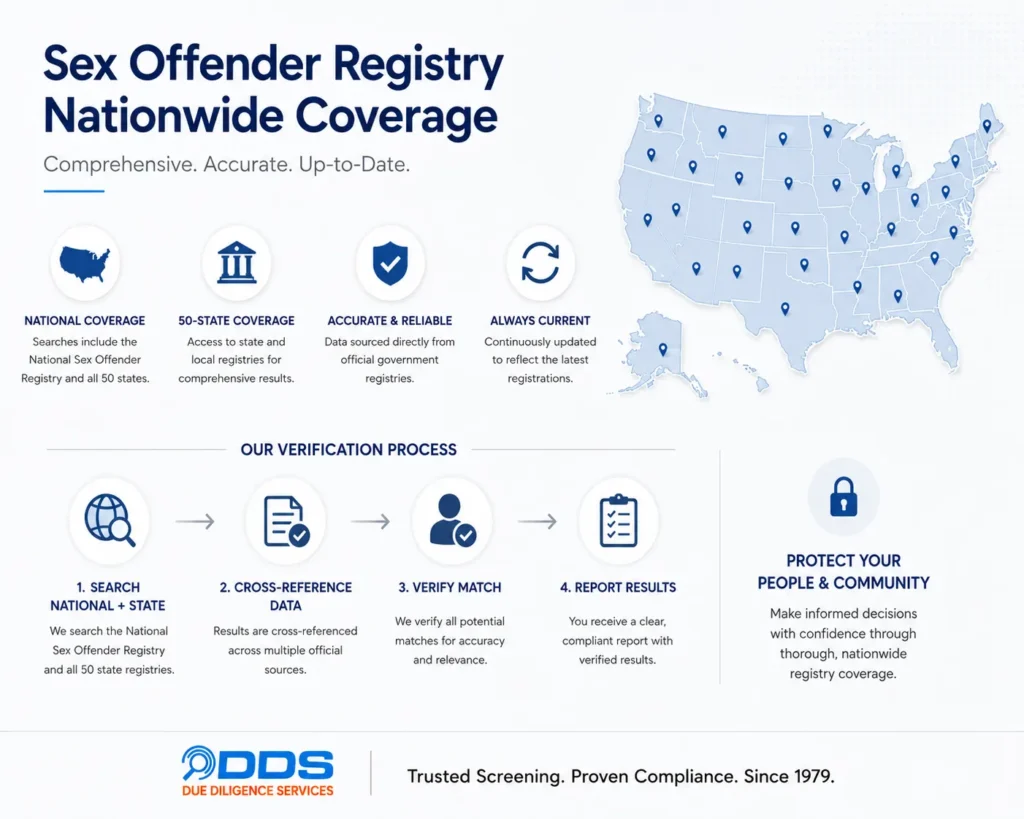
Verified Matches — Avoiding False Positives
A sex offender registry search is only useful if its results are accurate. A careless registry search that flags every name-only match floods the employer with false positives — common-name coincidences that aren’t the actual candidate. Worse, an unverified false match could wrongly damage an innocent applicant and expose the employer to liability.
DDS verifies every potential match before it appears on a report. Matches are confirmed through cross-referencing the personal data gathered from the screening request — and from the other searches DDS performs as part of the background check — against the registry record. Name, date of birth, address history, and other identifiers are compared to confirm that a registry hit actually belongs to the individual being screened.
This verification step is the difference between a registry search that creates noise and one that delivers reliable, actionable information. DDS reports confirmed matches — not raw, unverified name hits that the employer has to sort out themselves.
Protect the people your organization serves
A 20-minute consultation will show you how a verified sex offender registry search fits into your screening program — especially for roles involving children, patients, or other vulnerable populations. No obligation, no charge.
Standalone or Part of a Background Check
DDS offers the sex offender registry search both ways:
As a standalone service. For organizations that need a focused registry check — for example, re-screening existing volunteers or staff, or screening for a specific program requirement — DDS can run the sex offender registry search on its own.
Bundled into a full background check. More commonly, the sex offender registry search is included as one component of a comprehensive background check alongside criminal records, identity verification, and other searches. Bundled this way, the registry search benefits from the cross-referenced data the other searches provide — strengthening match verification.
Both options use the same national-and-50-state coverage and the same match-verification standard. The choice depends on the organization’s specific need, and DDS helps determine the right approach during the free consultation.
Industries Where Registry Screening Is Standard
A sex offender registry search is not mandated by federal statute for most private employers. But it has become a standard, expected safeguard across many industries — and in many cases an organization that skips it would be hard-pressed to defend that decision if something went wrong.
Registry screening is standard practice in:
– Childcare — daycare, after-school programs, babysitting and nanny placement
– Education — schools, universities, tutoring, coaching
– Healthcare and Eldercare — hospitals, nursing homes, home health, hospice, and other roles with patient contact
– Children’s Sports and Youth Programs — coaches, volunteers, and staff in youth athletics
– Volunteer Organizations — any organization placing volunteers in contact with vulnerable populations
– Transportation Services — rideshare, school transport, and other roles with passenger contact
For roles in these fields, a verified sex offender registry search is part of responsible hiring and a core element of protecting the people the organization serves — and of protecting the organization itself from negligent-hiring exposure.
Why Employers Choose DDS for Sex Offender Registry Searches
1. National plus all 50 states. Complete registry coverage — an individual registered anywhere surfaces, not just in a single searched state.
2. Verified matches, not raw hits. Every potential match is cross-referenced against personal data before it reaches your report, eliminating common-name false positives.
3. Standalone or bundled. Run it on its own or as part of a full background check — same coverage, same verification standard.
4. Protection for vulnerable-population roles. DDS understands the heightened responsibility of screening for childcare, education, healthcare, and youth-program roles.
5. The persistence and compliance standard. The same accuracy discipline DDS applies to every search applies here — verified, reportable, compliant results.
6. Operating since 1979. Decades of experience protecting organizations and the people they serve through accurate registry screening.
Frequently Asked Questions
What registries does a DDS sex offender registry search cover?
DDS searches the National Sex Offender Public Website (NSOPW), the U.S. Department of Justice national registry also associated with the Dru Sjodin National Sex Offender Public Website, plus all 50 individual state registries. This dual national-and-state coverage ensures an individual registered in one state doesn’t pass a search limited to another.
How does DDS avoid false positives?
Every potential match is verified before it appears on a report. DDS cross-references the personal data gathered from the screening request — and from the other searches performed as part of the background check — against the registry record, comparing name, date of birth, address history, and other identifiers to confirm the match belongs to the individual being screened. DDS reports confirmed matches, not raw name hits.
Is a sex offender registry search required by law?
For most private employers, a sex offender registry search is not mandated by federal statute. However, it has become a standard, expected safeguard in many industries — particularly childcare, education, healthcare, eldercare, and youth programs — where skipping it would be difficult to defend if an incident occurred. Some specific roles and state or local programs do carry statutory screening requirements.
What Is a Pre-Employment Background Check?
Can the registry search be run on its own?
Yes. DDS offers the sex offender registry search both as a standalone service and bundled into a comprehensive background check. The standalone option is useful for re-screening existing staff or volunteers or meeting a specific program requirement; the bundled option benefits from cross-referenced data from the other searches.
Which industries should use a sex offender registry search?
It’s standard practice in childcare, education, healthcare and eldercare, children’s sports and youth programs, volunteer organizations, and passenger-transport roles — anywhere employees or volunteers have contact with children, the elderly, patients, or other vulnerable populations.Typically one day. Because PACER centralizes federal court records, the federal criminal search is among the faster components of a background check.
How current is the registry data?
DDS searches the official national and state registries directly, so the data reflects what those authorities have published at the time of the search. Registries are maintained and updated by their issuing government authorities; DDS accesses them at the source rather than relying on a potentially stale third-party copy.
What information does a registry match include?
A confirmed registry match typically includes the offense information, conviction details, and registration data the official registry publishes. DDS reports the verified registry information consistent with FCRA requirements, with the same compliance review applied to every report before delivery.
How long does a sex offender registry search take?
A sex offender registry search is typically one of the faster components of a background check, since national and state registries are searchable electronically. When bundled into a full background check, it’s completed alongside the other searches; across all DDS services, 85% of orders complete within 24 hours.
Ready to Add Verified Registry Screening to Your Program?
A free consultation shows you how a verified, national-and-50-state sex offender registry search protects the people your organization serves — and protects your organization from negligent-hiring exposure. No obligation, no charge.