
Federal Criminal Search Services
Federal district court searches across all 94 U.S. districts — surfacing the federal crimes that county and state searches miss. Trusted since 1979.
A federal criminal search covers an entirely separate court system from county and state searches — and it surfaces crimes that never appear in local records. Federal crimes like fraud, drug trafficking, tax evasion, and interstate offenses are prosecuted in U.S. federal district courts, not county courthouses. DDS performs federal criminal searches across all 94 U.S. federal district courts, typically with one-day turnaround.
All 94 Federal District Courts
Catches Fraud, Trafficking & More
One-Day Turnaround
Trusted Since 1979
What Is a Federal Criminal Search?
A federal criminal search is a search of the United States federal district court records for criminal cases prosecuted at the federal level. It is a completely separate search from a county or state criminal search — different courts, different database, and an entirely different category of crimes.
This distinction matters because the U.S. has two parallel criminal justice systems. State and local crimes — most assaults, thefts, DUIs, and similar offenses — are prosecuted in county and state courts. Federal crimes — those that violate federal law or cross state lines — are prosecuted in U.S. federal district courts. A candidate could have a serious federal conviction that would never appear in any county or statewide criminal search.
DDS performs federal criminal searches across all 94 U.S. federal district courts, accessing PACER (Public Access to Court Electronic Records) for research and review of federal case records. The search surfaces federal criminal cases that a county-or-state-only screening program would completely miss.
What Federal Criminal Searches Catch That County Searches Miss
The entire value of a federal criminal search is that it surfaces crimes prosecuted only at the federal level — offenses that simply don’t appear in county or state court records. The most common federal crimes include:
– Drug Trafficking — large-scale drug distribution and trafficking, particularly across state lines
– Fraud and Financial Crimes — securities fraud, wire fraud, mail fraud, bank fraud, healthcare fraud, and embezzlement of federally insured funds
– Tax Evasion — federal income tax fraud and evasion
– Firearms Offenses — federal weapons violations, especially trafficking across state lines
– Cyber Crimes — computer fraud, hacking, and federal cybercrime offenses
– Immigration Violations — federal immigration-related offenses
– Human Trafficking — federal trafficking prosecutions
– Kidnapping — particularly cases crossing state lines
– Counterfeiting — currency and document counterfeiting
– Assault on a Federal Officer — crimes against federal personnel
These crimes cross all industry barriers. A candidate with a federal fraud conviction, a trafficking history, or a cybercrime record could pass a clean county search and still carry a serious federal criminal history. Whether a federal criminal search is essential for a given role depends on the employer’s risk profile — but for any position involving financial responsibility, sensitive data, or fiduciary trust, the federal search closes a gap that county-and-state screening leaves wide open.
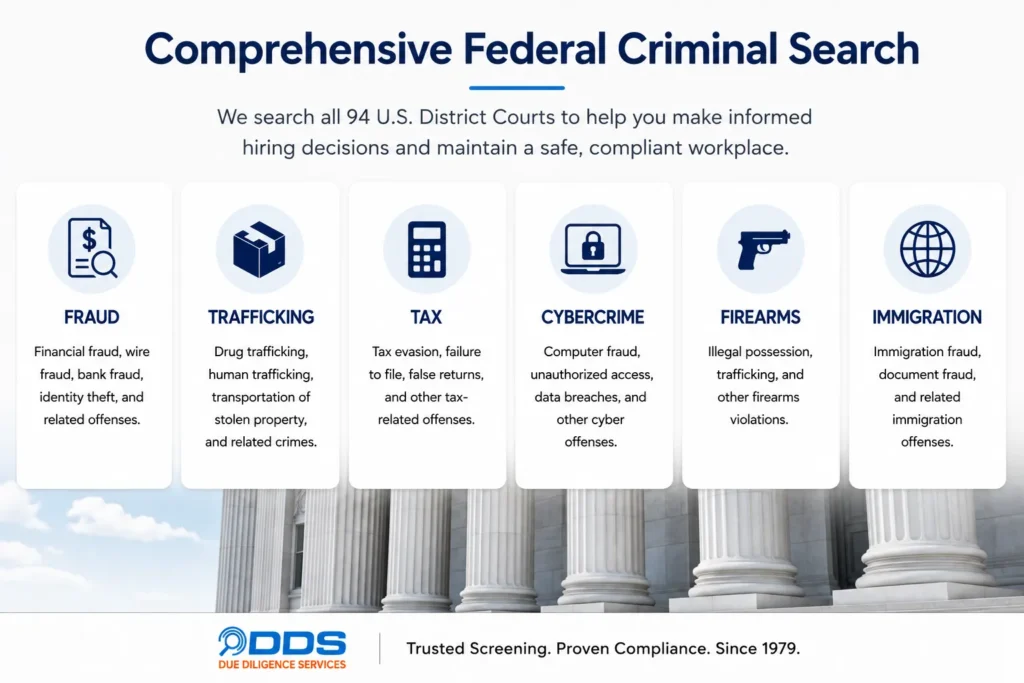
Coverage — All 94 Federal District Courts
The federal court system is organized into 94 federal judicial districts, each with its own U.S. district court. Every state has at least one federal district; larger states have multiple (California, Texas, and New York each have four).
DDS performs federal criminal searches across all 94 districts. Because federal records are centralized through PACER rather than scattered across thousands of individual county courthouses, a federal criminal search can be conducted comprehensively and quickly — DDS accesses the federal records for research and review and returns results typically within one day.
This national federal coverage means a DDS federal criminal search isn’t limited to where the candidate currently lives. Federal crimes prosecuted anywhere in the country surface in the search, regardless of which district handled the case — important because federal defendants are often prosecuted in districts far from their residence.
Is a federal criminal search right for your roles?
A 20-minute consultation will help you decide which roles warrant a federal criminal search in addition to county and state checks — and how to build it into a compliant, layered screening program. No obligation, no charge.
How DDS Conducts a Federal Criminal Search
DDS conducts federal criminal searches through direct access to the federal court record system:
PACER access for research and review. DDS accesses PACER, the federal judiciary’s electronic records system, to research and review federal criminal case records across all 94 districts.
Identity matching. Because federal records are matched on name and identifiers, DDS reviews potential matches carefully to confirm the record belongs to the candidate being screened — distinguishing actual matches from coincidental name similarities.
Compliance review. As with every DDS criminal search, federal results pass through compliance review before delivery. Only reportable, confirmed information reaches the client, consistent with FCRA requirements.
One-day turnaround. Because PACER centralizes federal records, the federal criminal search is among the faster components of a background check — DDS typically returns federal search results within one day.
A federal criminal search is most powerful when layered with county, statewide, and national searches as part of a complete criminal background screening program — each layer catching what the others can’t.
Why Employers Choose DDS for Federal Criminal Searches
1. All 94 districts. DDS searches every federal judicial district, so federal crimes prosecuted anywhere in the country surface regardless of where the candidate lives.
2. Catches what county searches miss. Fraud, trafficking, tax evasion, cybercrime, and interstate offenses are federal — a federal criminal search closes the gap county-and-state screening leaves open.
3. One-day turnaround. Among the fastest components of a background check, returned typically within one day.
4. Compliance-reviewed. Federal results pass through the same compliance review as every DDS criminal search before reaching the client.
5. Layered screening expertise. DDS knows when a federal criminal search adds real value and builds it into a layered program matched to each role’s risk profile — not a generic upsell.
6. Operating since 1979. Decades of experience interpreting federal court records and integrating them into compliant employment screening.
Frequently Asked Questions
What is the difference between a federal and a county criminal search?
A county criminal search covers crimes prosecuted in local and state courts — most assaults, thefts, DUIs, and similar offenses. A federal criminal search covers crimes prosecuted in U.S. federal district courts — fraud, drug trafficking, tax evasion, cybercrime, and interstate offenses. They are completely separate court systems and databases. A candidate can have a federal conviction that never appears in any county or state search.
How many federal courts does DDS search?
DDS performs federal criminal searches across all 94 U.S. federal district courts. Because federal records are centralized through PACER rather than spread across thousands of county courthouses, the search covers the entire country comprehensively.
What crimes show up in a federal criminal search?
County searches go directly to the courthouse — the most accurate source. Statewide searches query a state repository that covers all counties in that state, where a reliable one exists. Federal searches query a completely separate database covering federal crimes like fraud and interstate offenses. DDS layers these based on the candidate’s history and the role.
What Is a Pre-Employment Background Check?
Which roles need a federal criminal search?
Because federal crimes cross all industry barriers, whether a federal search is essential depends on the employer’s risk profile. It’s especially valuable for roles involving financial responsibility, fiduciary trust, sensitive data, executive authority, or government work — anywhere a fraud, trafficking, or cybercrime history would be disqualifying.
How long does a federal criminal search take?
Typically one day. Because PACER centralizes federal court records, the federal criminal search is among the faster components of a background check.
Does a national database search include federal records?
Not reliably. National database searches are useful pointers but are not a substitute for a direct federal district court search through PACER. For accurate federal criminal results, a direct federal search is required — which is what DDS performs across all 94 districts.
Can a candidate have a federal record but a clean county record?
Yes — and this is exactly why federal searches matter. Federal crimes are prosecuted in a separate court system. A candidate convicted of federal fraud, trafficking, or a cybercrime could pass a clean county and statewide search while carrying a serious federal criminal history.
Is a federal criminal search FCRA-compliant?
Yes. DDS conducts federal criminal searches as an FCRA-compliant Consumer Reporting Agency, with candidate authorization, compliance review before delivery, and pre-adverse and adverse action letter templates attached to applicable reports.
Close the Federal Gap in Your Screening Program
A free consultation will show you how a federal criminal search fits into a complete, layered background check program — and which of your roles need it most. No obligation, no charge.