
Substances of Abuse in the Workplace
What employers test for, what the panels cover, and what impairment actually costs — safety, productivity, and liability. Trusted since 1979.
Substances of abuse in the workplace are not an abstract concern — they show up as accidents, absences, turnover, and liability. Workplace overdose deaths have risen sharply over the past decade, and workers with substance use disorders miss substantially more work than their colleagues. Understanding which substances of abuse are tested for, what each testing panel covers, and where the emerging risks are is how an employer builds a program that actually addresses the problem. DDS has helped employers do exactly that since 1979.
Safety-Sensitive Focus
Emerging Substance Awareness
Trusted Since 1979
Since 1979 · 1M+ checks a year · 94% client retention · PBSA founding member
What Substances Are Tested For?
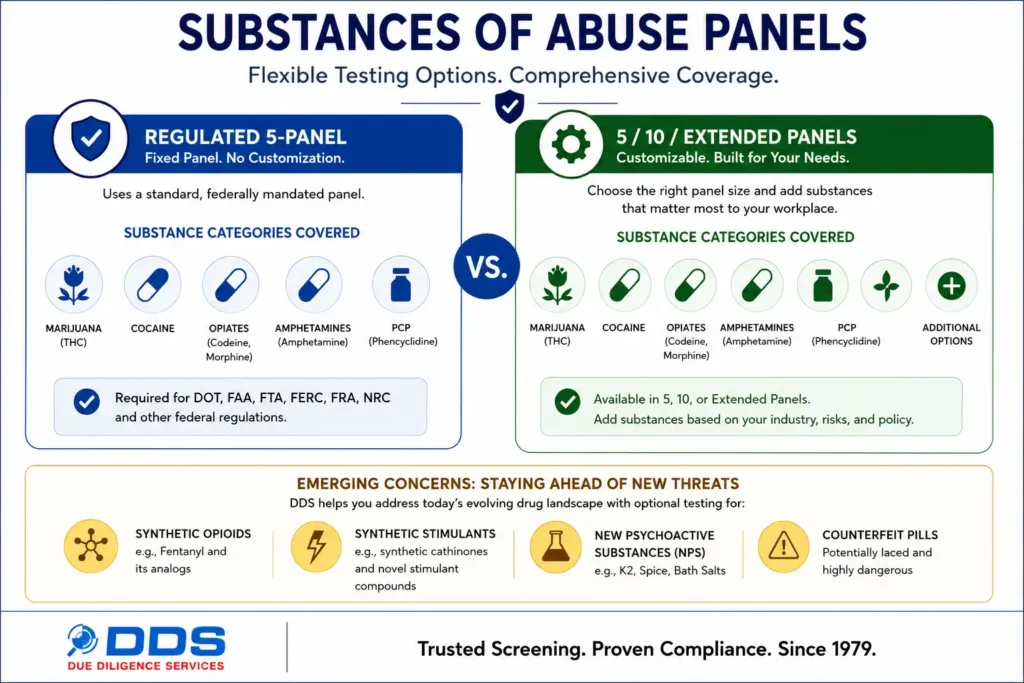
Workplace testing screens for the substances of abuse most associated with impairment, safety risk, and dependency. The specific list depends on the panel selected, but the commonly tested categories include:
– Marijuana (THC) — still the most frequently detected substance in workplace testing, with handling that varies significantly by state law
– Cocaine — a stimulant associated with erratic behavior and impaired judgment
– Opioids — including codeine, morphine, and heroin metabolites; expanded panels add semi-synthetic and synthetic opioids
– Amphetamines — including methamphetamine and MDMA on expanded panels
– Phencyclidine (PCP) — a dissociative associated with severe impairment
Broader panels extend beyond these to include barbiturates, benzodiazepines, methadone, propoxyphene, and expanded opioid coverage — categories where dependency and impairment are workplace concerns even when the substance was originally prescribed.
Which substances of abuse an employer tests for isn’t a one-size-fits-all decision. It depends on whether the workforce is federally regulated, the industry’s risk profile, and applicable state law.
Panels — Regulated vs. Customizable
There is one critical distinction in panel selection:
The regulated 5-panel is fixed. For federally regulated employers — DOT-covered roles under FMCSA, FAA, FRA, FTA, PHMSA, and USCG — the substances tested are dictated by federal rule. There is no customization. The regulated panel covers the federally specified substances of abuse, tested by the federally specified method, reviewed by a Medical Review Officer. An employer’s only job is to implement it correctly.
Everything else can be customized. For non-regulated employers, 5-panel, 10-panel, and extended-panel testing can all be customized to the workplace. A 5-panel covers the core categories. A 10-panel broadens into additional prescription and depressant categories. Extended panels reach further still, into expanded synthetic opioid coverage and other substances of abuse relevant to a specific industry or risk profile.
The right panel isn’t the biggest one — it’s the one matched to the actual risk. A construction contractor and a corporate office face different exposure, and paying for an extended panel where a standard one suffices is as much a mistake as under-testing a safety-sensitive workforce. This is where DDS consults rather than sells: the panel is designed around the employer’s roles, risks, and state-law environment.
What Substance Abuse Actually Costs Employers
The case for testing isn’t theoretical. Substances of abuse impose measurable costs across seven areas:
1. Safety risks and accidents. Impairment reduces focus, reaction time, and decision-making, increasing the likelihood of serious errors — especially in safety-sensitive roles across construction, transportation, and manufacturing. Workplace overdose deaths have risen dramatically over the past decade, now accounting for a meaningful share of on-the-job worker deaths, with opioids the leading cause. Construction, extraction, fishing, and trapping experience disproportionately high overdose death rates.
2. Reduced productivity. Substance misuse causes cognitive, emotional, and behavioral impairment that directly harms output and morale — concentration, memory, task completion, and reliability all degrade.
3. Absenteeism and presenteeism. Workers with substance use disorders miss substantially more work each year than the average worker — roughly five weeks annually. Just as costly is presenteeism: employees physically present but impaired, reducing output and raising risk to coworkers. Many workplace injuries lead to opioid prescriptions, which can escalate into misuse and further absence.
4. Turnover and replacement costs. Employees with substance use disorders turn over at higher rates, and replacing a worker typically costs from one-third to more than half of their annual salary depending on skill level.
5. Direct financial costs. Lost productivity, absenteeism, healthcare claims, workers’ compensation, and turnover compound into a significant financial burden — across a working population where tens of millions of employed Americans experience substance use disorders.
6. Culture and morale. Substance misuse erodes trust and teamwork. Coworkers feel unsafe or overburdened compensating for impaired colleagues, and chronic problems shift workplace norms toward tolerating unsafe behavior.
7. Legal and compliance risk. Employers face liability when impaired workers cause accidents, particularly in regulated industries. Failure to maintain a drug-free workplace can jeopardize contracts, insurance, and regulatory standing.

“I cannot say enough positive things when it comes to customer service and working with DDS. We have been particularly impressed with the consistency of service and the reliability of the staff. They are fabulous!”
Jennifer
RedPeak
Which substances should your program test for?
A 20-minute consultation matches the panel to your workforce — regulated requirements where they apply, and a customized panel where you have choices. No obligation, no charge.
Emerging Substances of Concern
The substances of abuse landscape is moving faster than it has in decades. Four categories now sit at the top of employer concern:
Ultra-potent synthetic opioids. Far more potent than traditional opioids, active at minute doses, and responsible for a growing share of overdose deaths. Their potency means the margin between use and fatal overdose is extremely narrow.
New synthetic stimulants. Continually reformulated stimulant compounds producing unpredictable effects, agitation, and impairment.
New psychoactive substances (NPS). A broad, constantly changing category engineered to mimic established drugs. Because their chemical structures shift frequently, standard panels may not detect them.
Counterfeit and fake pills. Pills manufactured to look like legitimate prescription medication but containing entirely different substances, often synthetic opioids, in unknown doses. Users frequently don’t know what they’ve taken.
What makes these categories a distinct employer problem is the combination: they spread rapidly, often go undetected on standard panels, and produce unpredictable effects. An employee may be seriously impaired — or at risk of overdose — without any of the familiar indicators.
The practical response isn’t panic; it’s program design. Employers concerned about emerging substances of abuse should discuss expanded panel coverage, reasonable-suspicion training for supervisors, and keeping the testing program current as detection capabilities evolve. DDS reviews panel coverage with clients as the landscape changes.
How DDS Approaches Substance Testing
1. Classification first. Regulated roles get the federally mandated panel, implemented exactly. Non-regulated roles get a consultative panel design.
2. Risk-matched panels. 5-panel, 10-panel, or extended coverage selected against the actual roles and risks — not upsold, and not under-scoped for safety-sensitive work.
3. SAMHSA-certified laboratories. All testing runs through certified laboratories, with results reviewed by a Medical Review Officer — the same MRO partnership DDS has maintained for over 30 years.
4. Ongoing review. As substances of abuse evolve and detection capabilities change, DDS revisits panel coverage with clients rather than leaving a program frozen at its launch configuration.
5. Policy alignment. Every panel decision is reflected in the written [drug testing policy](/drug-testing/drug-testing-policy/), so what’s tested and what happens on a positive result are documented before testing begins.
Frequently Asked Questions
What substances of abuse are tested for in workplace drug testing?
Commonly tested categories include marijuana (THC), cocaine, opioids, amphetamines, and phencyclidine (PCP). Broader panels extend to barbiturates, benzodiazepines, methadone, propoxyphene, and expanded synthetic opioid coverage. The exact list depends on the panel selected and whether the employer is federally regulated.
What's the difference between a 5-panel and a 10-panel test?
A 5-panel covers the core substance categories; a 10-panel broadens into additional prescription and depressant categories. For non-regulated employers, 5-panel, 10-panel, and extended-panel testing can all be customized. For federally regulated employers, the panel is dictated by federal rule and cannot be customized.
Can we customize which substances we test for?
Only if you’re non-regulated. Regulated employers must use the federally specified panel exactly as prescribed. Non-regulated employers can customize 5-panel, 10-panel, and extended panels to match their industry, risk profile, and state-law environment — and DDS consults on that design.
Should we test for more substances to be safer?
Not automatically. The right panel is the one matched to actual risk, not the largest one available. Paying for extended coverage where a standard panel suffices is as much a mistake as under-testing a safety-sensitive workforce. DDS recommends the panel that fits the roles.
What emerging substances should employers worry about?
Four categories: ultra-potent synthetic opioids, new synthetic stimulants, new psychoactive substances (NPS), and counterfeit or fake pills. They spread quickly, may not be detected on standard panels, and produce unpredictable effects — which is why panel coverage should be reviewed periodically rather than set once.
Does substance abuse really affect workplace performance measurably?
Yes. Workers with substance use disorders miss substantially more work than average, and impairment degrades concentration, memory, task completion, and reliability. Add higher turnover, elevated healthcare and workers’ compensation claims, and accident liability, and the financial impact is significant and well documented.
How does marijuana factor in, given changing state laws?
Marijuana remains the most frequently detected substance in workplace testing, and its handling varies considerably by state. Federally regulated employers must continue testing for it regardless of state law. Non-regulated employers face a state-by-state landscape, which is one of the specific areas DDS advises on during program design.
Match Your Panel to Your Actual Risk
A free consultation reviews which substances of abuse your program should cover, whether your panel fits your roles, and how to keep it current as the landscape changes. No obligation, no charge.