
Social Security Trace
The identity foundation of every thorough background check — confirming identity, surfacing alias names, and mapping address history through the SSN. Trusted since 1979.
A social security trace is used to confirm identity — surfacing any alias names or different spellings of a name used through the SSN, as well as the current and former addresses associated with that SSN. It’s a standalone product, but it has become the first standard search of a comprehensive background check, because everything that follows depends on knowing exactly who you’re screening and where they’ve lived. DDS performs the social security trace as the identity foundation that makes the rest of the background check accurate.
Confirms Identity Through the SSN
Surfaces Aliases & Name Variations
Maps Current & Former Addresses
Trusted Since 1979
What Is a Social Security Trace?
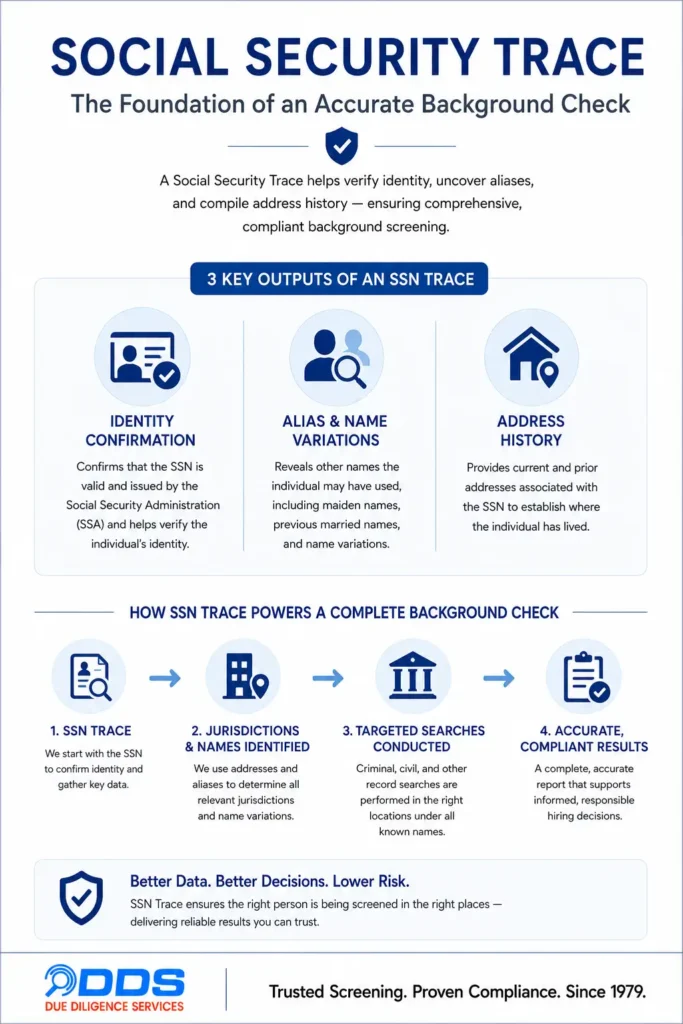
A social security trace is an identity-confirmation search built around a candidate’s Social Security Number. It reveals three things that form the foundation of an accurate background check:
Identity confirmation. The social security trace confirms that the SSN — issued by the Social Security Administration — belongs to the person being screened — establishing that the identity is genuine before any other search begins.
Alias names and name variations. The trace surfaces any alias names or different spellings of the name that have been used through that SSN. This matters enormously: a candidate’s records may exist under a maiden name, a shortened name, a different spelling, or an alias — and searches run only under the name on the application would miss them.
Current and former addresses. The trace maps the current and former addresses used through that SSN, building the residency history that determines where criminal and civil searches should be run.
In short: the social security trace answers “who exactly is this person, what names have they used, and where have they lived?” — the three questions every other search depends on.
Standalone Product, Standard First Step
The social security trace is a standalone product — it can be ordered on its own when identity confirmation is the specific need. But in practice, it has become the first standard search of a comprehensive background check, and for good reason.
Consider what happens without it. A criminal search run only under the applicant’s stated name, in only the county they listed, will miss records held under a maiden name, an alias, or in a county the applicant didn’t mention. The search “comes back clean” — but the cleanliness is an illusion created by searching the wrong name in the wrong places.
The social security trace prevents this. By surfacing every name variation and every address associated with the SSN, it tells the rest of the background check where to look and under which names. The subsequent county, statewide, and federal searches are then run against the complete picture — not just the version the applicant provided.
This is why DDS treats the social security trace as the identity foundation of the screening process: it’s the search that makes every other search accurate.
What a Social Security Trace Is Not
Honest scope matters, so here’s what a social security trace does not do:
It is not a credit check. Although the trace draws on credit-header data, it contains no credit accounts, balances, payment history, or scores. Ordering a social security trace does not access the candidate’s credit file in the way a credit report does, and it has no impact on their credit.
It is not identity theft protection. The trace confirms identity for screening purposes at a point in time — it doesn’t monitor the SSN or protect the candidate against fraud.
It is not a criminal search. The trace itself contains no criminal records. Its job is to direct the criminal searches — telling them which names and jurisdictions to cover.
Understanding these limits is part of using the social security trace correctly: it’s the identity and residency foundation of the background check, not a substitute for the searches built on top of it.
Build your background checks on a solid identity foundation
A 20-minute consultation will show you how the social security trace anchors an accurate, comprehensive screening program — and why searches without it can miss what matters. No obligation, no charge.
How DDS Uses the Social Security Trace
1. Identity confirmation first. The trace runs at the start of the background check, confirming the SSN and the identity behind it before other searches begin.
2. Alias and name-variation surfacing. Every name and spelling variation used through the SSN is identified, so subsequent searches cover all of them — not just the name on the application.
3. Residency mapping. The current and former addresses associated with the SSN build the jurisdiction list for county and statewide criminal searches, focusing the search where the candidate has actually lived.
4. Feeding the comprehensive check. The trace results flow directly into the rest of the DDS screening workflow — criminal searches, verifications, and registry checks all run against the complete identity picture the trace establishes.
Ordered standalone, the social security trace delivers the identity, alias, and address information on its own. Ordered as part of a comprehensive background check — its most common use — it silently makes every other component more accurate.
Why Employers Choose DDS for Social Security Traces
1. The accuracy foundation. DDS runs the social security trace as the first standard search, so every subsequent search covers the right names in the right places.
2. Alias-aware screening. Records under maiden names, shortened names, and spelling variations don’t slip through — the trace surfaces them all.
3. Honest scope. DDS is clear about what the trace does and doesn’t do — it’s an identity tool, not a credit check or a criminal search.
4. Standalone or integrated. Order it on its own for identity confirmation, or as the built-in first step of a comprehensive background check.
5. Compliance discipline. Like every DDS search, trace results are handled within FCRA requirements with compliance review before delivery.
6. Operating since 1979. Decades of building accurate screening programs on the identity foundation the trace provides.
Frequently Asked Questions
What is a social security trace?
Start Every Background Check on the Right FoundationA social security trace is an identity-confirmation search built around a candidate’s Social Security Number. It confirms identity, surfaces any alias names or different spellings of the name used through the SSN, and maps the current and former addresses associated with that SSN — the foundation the rest of a background check is built on.
Is a social security trace a credit check?
No. Although the trace draws on credit-header data, it contains no credit accounts, balances, payment history, or scores, and it has no impact on the candidate’s credit. It is an identity tool, not a credit report.
Why is the social security trace run first?
Because every other search depends on it. The trace surfaces the name variations and addresses that tell criminal and civil searches which names to search and which jurisdictions to cover. Searches run without it can miss records held under a maiden name, an alias, or in a county the applicant didn’t list.
Why Employers Choose DDS for Employment Verification
Can I order a social security trace on its own?
Yes. The social security trace is a standalone product and can be ordered when identity confirmation is the specific need. In practice, it has also become the first standard search of a comprehensive background check.
What are alias names and why do they matter?
Aliases include maiden names, shortened or changed names, and different spellings used through the SSN. They matter because records — criminal, civil, or otherwise — may exist under those names. A search limited to the name on the application would miss them; the trace ensures they’re covered.
Does the social security trace show where someone has lived?
Yes. The trace maps the current and former addresses used through the SSN, building the residency history that determines where county and statewide searches should be run within the applicable search timeframe.
Does a social security trace verify employment eligibility?
No — that’s a separate process. Employment eligibility is handled through I-9 and E-Verify. The social security trace confirms identity for screening purposes; it is not a work-authorization check.
Why Employers Choose DDS for Employment Verification
How fast is a social security trace?
The social security trace is typically one of the fastest components of a background check — generally returned quickly at the start of the screening process so the rest of the searches can be targeted correctly. Across all DDS services, 85% of orders complete within 24 hours.
Start Every Background Check on the Right Foundation
A free consultation shows you how the social security trace anchors accurate screening — identity confirmed, aliases surfaced, jurisdictions mapped. No obligation, no charge.