
Passport Verification Services
Authenticating identity, validity, and country of origin — especially for foreign-born applicants whose home-country documents are difficult to verify. Trusted since 1979.
Passport verification confirms that a passport is authentic, that the identity it presents is genuine, and that the document is valid — including the holder’s country of origin. It’s used mostly for the identification of foreign-born applicants, where verifying other identification documentation from their home country may be difficult or impossible. In those cases, the passport is often the strongest, most verifiable identity document available — and DDS passport verification confirms it properly, using physical inspection, security-feature verification, global ID checking, and validity confirmation.
Authenticity, Identity & Validity
Country of Origin Confirmed
MRZ, Chip & Security Features
Trusted Since 1979
What Is Passport Verification?
Passport verification is the authentication of a passport as a genuine, valid identity document. A proper passport verification confirms four things:
– Authenticity — the passport is a genuine government-issued document, not a forgery
– Identity — the document genuinely belongs to and identifies the person presenting it
– Validity — the passport is current, unexpired, and shows no signs of tampering
– Country of origin — the issuing country and the holder’s origin are confirmed
For employers, passport verification answers a foundational question: is this person who they say they are? When the answer rests on a foreign-issued document, verifying it properly requires more than a glance — it requires knowing what a genuine passport from that country looks like, which security features it carries, and how to check them.
Why It Matters Most for Foreign-Born Applicants
Passport verification is used mostly for the identification of foreign-born applicants — and the reason is practical.
For a U.S.-born candidate, identity can usually be confirmed through multiple domestic channels: the Social Security trace, state-issued ID, and domestic records that cross-reference each other. For a foreign-born applicant, those domestic anchors may be thin or recent — and verifying other identification documentation from their home country can be difficult or impossible. Birth certificates, national ID cards, and regional documents from some countries can’t be reliably authenticated from the U.S.
The passport solves this. It’s an internationally standardized document, built to be verified across borders, carrying machine-readable and physical security features that can be authenticated regardless of the issuing country. When home-country documents can’t be verified, the passport is often the strongest identity evidence a foreign-born applicant has — and passport verification confirms it properly.
This makes passport verification a natural companion to the rest of the screening process for international hires: it anchors the identity, so the searches and verifications built on that identity are reliable.
How Passport Verification Is Done
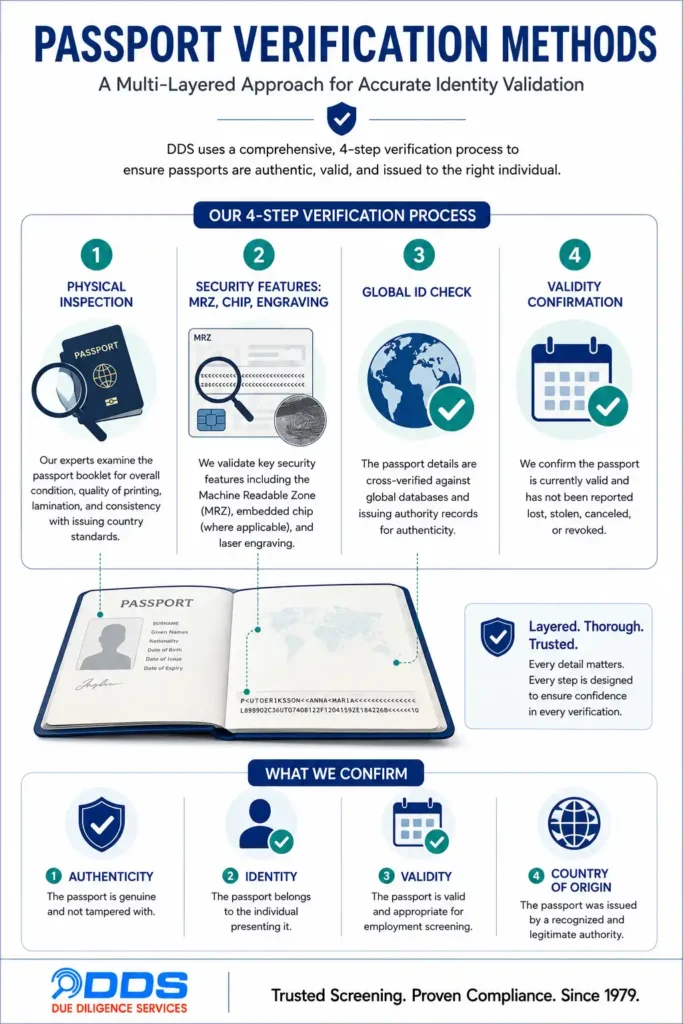
DDS passport verification uses layered authentication methods, applying the ones appropriate to each situation:
Physical inspection. Direct examination of the physical document — required for I-9 purposes, where the employer must physically inspect original documents. The passport is reviewed as a physical object: construction, materials, and overall integrity.
Security-feature verification. Modern passports carry engineered security features designed for authentication: the Machine Readable Zone (MRZ) that encodes the holder’s data in a standardized, checkable format; the embedded chip in e-passports carrying the holder’s digital data; and physical features like engraving and security printing. These features are checked for presence, consistency, and integrity.
Global ID Check. Verification of the document and identity against international identity-checking resources — extending the authentication beyond what physical inspection alone can confirm.
Validity confirmation. Confirming the passport is unexpired and shows no signs of tampering — alterations, substituted pages or photos, or inconsistencies between the document’s elements.
Together, these methods answer the authenticity, identity, validity, and origin questions with far more confidence than a visual glance ever could.
Hiring internationally or verifying foreign-born applicants?
A 20-minute consultation will show you how passport verification anchors reliable identity for international hires — and how it fits alongside your I-9 process and the rest of your screening program. No obligation, no charge.
When Employers Use Passport Verification
Passport verification earns its place in a screening program in several situations:
– International hires and foreign-born applicants — the primary use case: anchoring identity when home-country documents can’t be reliably verified
– Security clearance pre-screening — roles heading toward clearance processes, where identity and origin must be established early and correctly
– Travel-required roles — positions involving international travel, where a valid passport is an operational requirement
– High-assurance identity contexts — any role where the organization needs identity established to a documentary standard
In each case, the passport verification serves the same function: converting a document that most employers can’t properly evaluate into confirmed, reliable identity evidence.
Why Employers Choose DDS for Passport Verification
1. Layered authentication. Physical inspection, security-feature verification (MRZ, chip, engraving), Global ID Check, and validity confirmation — not a visual glance.
2. Built for the hard cases. Focused on foreign-born applicants, where home-country documents are difficult to verify and the passport is the strongest identity anchor available.
3. Country of origin confirmed. Beyond authenticity and validity, the verification establishes the issuing country and origin.
4. Fits the I-9 workflow. The physical-inspection component aligns with I-9 requirements, and DDS’s I-9 and E-Verify support connects the identity verification to the work-authorization process.
5. Anchors the whole screening. A confirmed identity makes every other search and verification in the program more reliable.
6. Operating since 1979. Decades of international screening experience across 100+ countries.
Frequently Asked Questions
What does passport verification confirm?
Passport verification confirms four things: that the passport is authentic (a genuine government-issued document), that the identity it presents is genuine, that the document is valid (unexpired and untampered), and the holder’s country of origin.
Who is passport verification for?
It’s used mostly for the identification of foreign-born applicants, where verifying other identification documentation from their home country may be difficult or impossible. It’s also used for security clearance pre-screening, travel-required roles, and any position needing identity established to a documentary standard.
How is a passport verified?
DDS uses layered methods: physical inspection of the document (required for I-9 purposes), security-feature verification including the Machine Readable Zone, embedded chip, and engraving, a Global ID Check against international identity resources, and validity confirmation checking expiration and signs of tampering.
What is the Machine Readable Zone (MRZ)?
The MRZ is the standardized, machine-readable strip on a passport’s data page that encodes the holder’s information in an internationally consistent, checkable format. Verifying the MRZ — and its consistency with the rest of the document — is a core part of passport authentication.
Does passport verification cover foreign passports?
Yes — that’s its primary purpose. Passports are internationally standardized documents built to be verified across borders, which is exactly why they’re the strongest identity anchor for foreign-born applicants whose other home-country documents can’t be reliably authenticated from the U.S.
Is passport verification the same as I-9 verification?
They’re related but distinct. I-9 is the work-authorization process, in which a passport can serve as a List A document requiring the employer’s physical inspection. Passport verification is the deeper authentication of the document itself — its genuineness, security features, validity, and the identity behind it. DDS supports both, and they work together for international hires.
Can a passport be faked?
Forged and altered passports exist, which is why proper verification checks the engineered security features — MRZ consistency, the embedded chip, engraving and security printing — and looks for tampering signs like substituted photos or pages. These layered checks are designed to catch what a visual glance misses.
Why Employers Choose DDS for Employment Verification
How does passport verification fit into a background check?
It anchors the identity at the front of the process, much like the Social Security trace does for domestic applicants. With the identity confirmed, the searches and verifications built on that identity — criminal, education, employment — are reliable. For foreign-born applicants, DDS pairs passport verification with its international screening capabilities across 100+ countries.
Anchor Identity for Your International Hires
A free consultation shows you how passport verification establishes reliable identity for foreign-born applicants — authenticated properly, integrated with your I-9 process and full screening program. No obligation, no charge.