
Random Screening
Automated, defensible random pools — built to the exact percentages your regulation requires. Trusted since 1979.
Random screening is the backbone of an effective drug and alcohol testing program — and the component most vulnerable to challenge if it isn’t administered correctly. A random screening pool must be genuinely random, documented, and sized to the testing percentages the governing regulation requires. DDS administers random screening through an electronic, automated pool where subjects are entered as identifiers rather than names, so selections are made blind and matched to individuals only afterward. That’s what makes a random screening program defensible when it matters.
Blind, Number-Based Selection
Built to Regulatory Percentages
Electronic & Automated
Trusted Since 1979
What Is Random Screening?
Random screening is unannounced drug and alcohol testing in which employees are selected by chance rather than by suspicion, schedule, or supervisor choice. Its value comes entirely from its unpredictability: because no employee can know when they might be selected, random screening deters use in a way that scheduled testing cannot.
That deterrent effect only holds if the selection is genuinely random — and only holds up legally if the employer can demonstrate it. A random screening program where selections appear targeted, where the same employees are repeatedly chosen, or where the process can’t be documented invites exactly the challenge it was meant to prevent.
DDS administers random screening as an electronic, automated process built to the requirements governing each client’s workforce, with documentation that stands up to scrutiny.
How the Random Pool Works
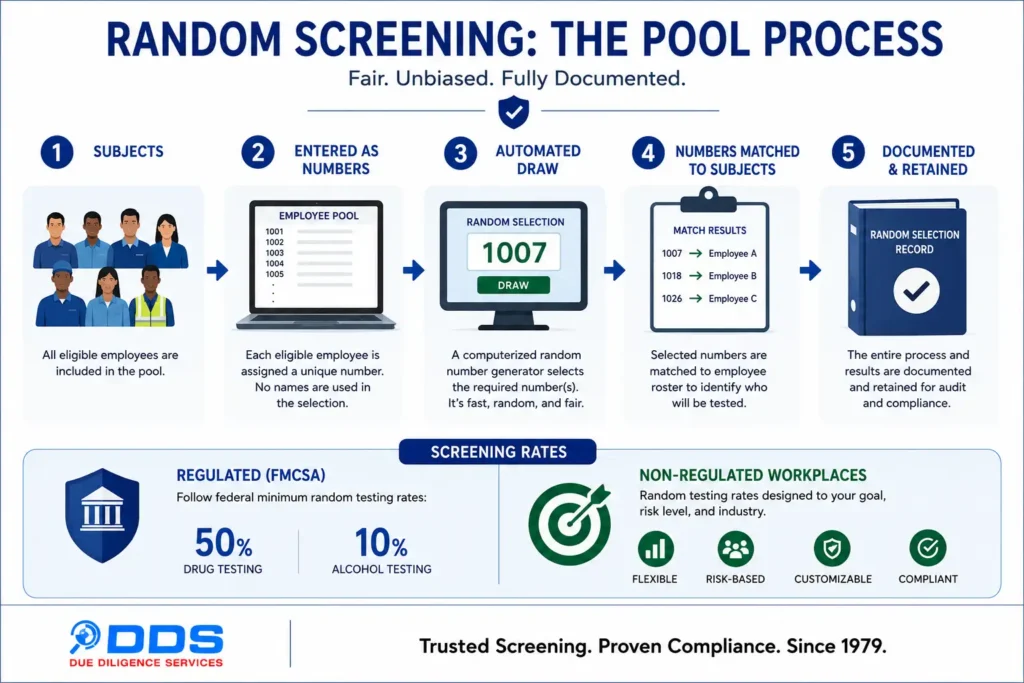
The defensibility of random screening rests on how the pool is built and how selections are made. DDS uses a blind, identifier-based process:
1. Subjects are entered as identifiers, not names. Every person in the pool is represented by a number. The pool itself contains no names at the point of selection.
2. Selection is electronic and automated. The system draws from the pool of identifiers. No human chooses who is tested, and no one selecting can see whose number is whose.
3. Numbers are matched to subjects only after selection. Once the draw is complete, the selected identifiers are matched back to the individuals they represent.
This sequence is the whole point. Because selection happens against numbers rather than people, it is structurally impossible for the process to target an individual — and that structure is what an employer can point to if a random screening selection is ever questioned. “The system selected number 0472, and 0472 turned out to be this employee” is a fundamentally different position than “our manager pulled a name.”
Random Screening Rates and Regulatory Compliance
Every random screening pool DDS creates is built to match the compliance requirements of the governing regulation — specifically, the percentage of the pool that must be tested for drugs and for alcohol annually.
For federally regulated employers, those percentages are set by the regulating agency and are not optional. Under FMCSA, for example, the current annual random testing rates are 50% of the average number of driver positions for controlled substances and 10% for alcohol. Other DOT agencies set their own rates, and agencies review and may adjust these rates annually based on industry violation data.
DDS handles this automatically. The pool is sized and the selections are scheduled so the required annual percentages are met across the testing year — spread through the year rather than clustered, as the regulations contemplate. Employers do not have to track their own rates or calculate whether they’re on pace.
Because rates can change from year to year, DDS monitors the applicable requirements and adjusts client random screening programs accordingly, rather than leaving a program configured to a rate that has since changed.
Is your random program actually defensible?
A 20-minute consultation reviews how your random screening is administered, whether your pool meets the required annual percentages, and whether your documentation would hold up if challenged. No obligation, no charge.
Non-Regulated Random Screening Programs
Employers outside federal regulation aren’t bound to a mandated percentage — which means the structure of a non-regulated random screening program is a decision rather than a requirement.
That decision should follow from the employer’s goal. An organization focused primarily on deterrence may want a higher selection rate so employees perceive real likelihood of testing. An organization addressing a specific safety-sensitive population may limit the pool to those roles. An organization balancing cost against risk may set a rate that maintains credibility without over-testing.
DDS structures non-regulated random screening around that goal through consultation — reviewing the workforce, the risk profile, applicable state law, and what the employer is actually trying to achieve, then designing the pool, the rate, and the schedule to match. The same blind, identifier-based selection process applies, so a non-regulated random screening program is just as defensible as a regulated one.
Whatever structure is chosen, it belongs in the written drug testing policy — the selection method, the rate, the covered population, and the consequences of a positive result documented before the first draw.
Why Employers Choose DDS for Random Screening
1. Blind, identifier-based selection. Subjects enter the pool as numbers, selection is automated, and identities are matched only afterward — structurally impossible to target an individual.
2. Built to your regulation’s percentages. Pools are created to match the annual drug and alcohol testing rates the governing regulation requires, monitored and adjusted as rates change.
3. Automated administration. DOT random rates are handled automatically. Employers don’t track their own compliance pace.
4. Consultative design for non-regulated programs. Rate, pool, and schedule built around the employer’s actual goal rather than a default template.
5. Documented and defensible. The process produces the documentation an employer needs if a selection is ever challenged.
6. One provider, end to end. Collection network, SAMHSA-certified laboratories, and MRO review connected through DDS, with a live person answering the phone.
Frequently Asked Questions
What is random screening?
Random screening is unannounced drug and alcohol testing in which employees are selected by chance rather than by suspicion, schedule, or supervisor choice. Its deterrent value comes from unpredictability — no employee can know when they might be selected.
How does DDS make sure the selection is genuinely random?
Subjects are entered into an electronic, automated pool as identifiers — numbers, not names. The system draws from those numbers, and selected identifiers are matched back to individuals only after the draw is complete. Because selection happens against numbers rather than people, targeting an individual is structurally impossible.
What are the DOT random testing rates?
Rates are set by each DOT agency. Under FMCSA, the current annual rates are 50% of average driver positions for controlled substances and 10% for alcohol. Agencies review these rates annually and may adjust them based on industry violation data. DDS monitors the applicable rates and administers client pools to meet them automatically.
Does DDS handle DOT random rates automatically?
Yes. The pool is sized and selections are scheduled so the required annual percentages are met across the testing year, spread through the year rather than clustered. Employers do not need to track their own rates or calculate whether they are on pace.
How should a non-regulated random screening program be structured?
There is no mandated percentage outside federal regulation, so the structure follows the employer’s goal — deterrence, a specific safety-sensitive population, or a balance of cost against risk. DDS designs the pool, rate, and schedule through consultation, and the same blind identifier-based selection applies.
What documentation proves our random selection was fair?
The identifier-based process produces the record: subjects entered as numbers, an automated draw against those numbers, and identities matched only afterward. That sequence, documented, is what an employer points to if a selection is challenged — a materially stronger position than a manually chosen name.
Can an employee be selected twice in a row?
Yes. Genuine randomness means every eligible person has a chance in every draw, including someone recently selected. Removing recently tested employees from the pool would make selections predictable and undermine both the deterrent effect and the defensibility of the program.
Random Screening That Holds Up
A free consultation reviews your pool, your rates, and your documentation — and shows how automated, identifier-based random screening keeps your program both compliant and defensible. No obligation, no charge.