
Criminal Records Check Services
County, State, Federal, and National (cursory) criminal searches — Compliance-reviewed before every report to ensure protection for all concerned parties. Trusted since 1979.
A criminal records check is only useful to the Employer if it’s accurate, current, complete and compliant. After initial consultation, DDS formulates a standardized comprehensive strategy for specific jurisdictional searches that correspond to each candidate’s history. Reports disseminated to clients are compliance reviewed as a pre-emptive protection for the client and candidate. This protection assures that all information reported can be used in making an informed hiring decision.
Convictions Only — Never Pending Charges
Jurisdiction-Specific Searches
Compliance-Reviewed Before Delivery
Trusted Since 1979
What Is a Criminal Records Check?
A criminal records is a search of court and law-enforcement records to identify an individual’s criminal conviction history. For employers, it’s one of the most important — and most legally regulated — components of a pre-employment screening program.
The challenge with criminal records checks isn’t running a search. It’s running the right searches in the right jurisdictions, interpreting the results correctly, and reporting only what’s legally permissible for an employer to consider. A criminal check done carelessly is worse than no check at all: it exposes the employer to FCRA litigation, EEOC discrimination claims, and negligent-hiring liability all at once.
DDS approaches criminal records checks the way a 47-year-old screening firm should: jurisdiction logic built around where the candidate actually lived and worked, layered database and direct-court searches, convictions-only reporting, and a mandatory compliance review on every single report before it’s delivered.
Types of criminal records searches DDS Performs
Criminal records in the United States are not stored in a single national database. They’re held across thousands of separate county courts, state repositories, and federal district courts — each with its own access rules, update frequency, and completeness. A thorough criminal records check layers multiple search types:
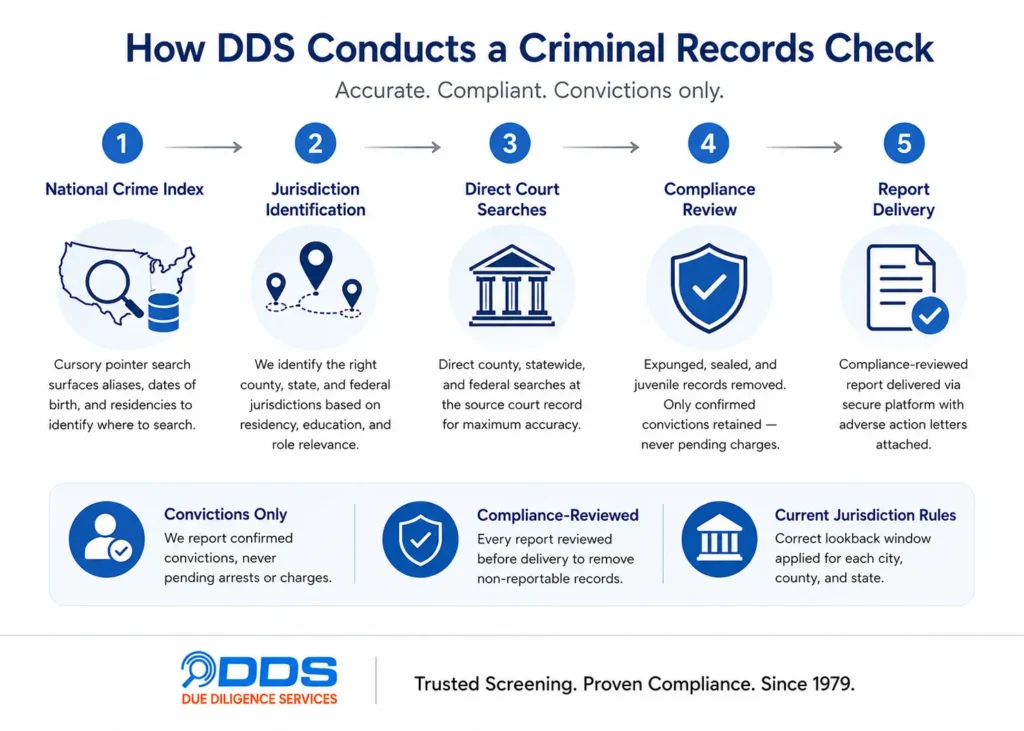
National Crime Index. DDS’s National Crime Index is a broad, cursory database search. It is not a final result — it’s a pointer. The Index allows DDS to cross-reference alias names, dates of birth, and prior residencies so we can identify which specific jurisdictions warrant a direct search. With the client’s permission, we then search those jurisdictions directly via county courts or statewide repositories.
Statewide Repository Searches. Where a state maintains a reliable, current statewide criminal repository, DDS recommends searching it — because a single statewide search covers all counties within that state. We recommend statewide searches when the repository is available and updated to our standard.
County criminal records searches. Where a state has no statewide repository, or where the repository is not updated frequently enough to be reliable, DDS recommends direct county-level searches at the courthouse. County searches are the gold standard for accuracy because they go directly to the source court record.
Federal criminal records searches. Federal crimes are held in a completely separate database from state and county records and include different categories of offense — fraud, embezzlement, interstate crimes, federal regulatory violations. Federal searches are particularly relevant for roles involving financial responsibility, and DDS often recommends them based on current or previous job titles where federal-category crimes would be most relevant.
How DDS Determines Which Jurisdictions to Search for criminal records
This is where experience matters most. Because every DDS client has a customized service menu, we recommend which criminal jurisdictions to search based on information availability and relevance — not a one-size template.
Our jurisdiction logic:
Residency history. DDS searches jurisdictions where the candidate has lived within the applicable search timeframe. The National Crime Index and SSN trace surface address history, which guides where direct searches are warranted.
Higher education locations. Where a candidate attended college or other higher education during the search timeframe, those jurisdictions are also relevant — people commit and are convicted of crimes where they study, not just where they live.
Statewide vs. county decision. If a reliable statewide repository exists, DDS recommends it because it captures all encompassing counties in one search. If no statewide repository exists, or if it isn’t updated to our satisfaction, we recommend direct county searches.
Federal relevance. Because federal records are a separate database covering different crimes, DDS recommends federal searches based on the relevance to the role — particularly for positions involving financial authority, fiduciary responsibility, or regulated industries where federal-category offenses matter most.
The result is a search strategy matched to the individual candidate and the specific role — not a generic package that over-searches some candidates and under-searches others.
Convictions Only — Our criminal records Reporting Standard
DDS reports only confirmed criminal convictions. We do not report pending arrests or charges.
This is a deliberate compliance decision, and it protects both the client and DDS.
Here’s why it matters: if DDS reported a pending arrest, and a client used that information to make a hiring decision, and the case was later dismissed or resulted in no conviction — both the client and DDS would face significant exposure to non-compliance litigation. Reporting unresolved charges invites EEOC disparate-impact claims and FCRA accuracy disputes.
We cannot imply or speculate about how a pending court case will resolve, so we don’t put that information in front of a client at all. A criminal record reported by DDS is a confirmed conviction — information an employer can legally consider, document, and act on within FCRA and EEOC frameworks.
Compliance Review Before Every Report
Every DDS criminal records report goes through a compliance review before it reaches the client. During this review, DDS ensures that no expunged, sealed, or juvenile records appear on the report.
This matters because raw court data sometimes contains records that should never be reported to an employer:
– Expunged records — convictions legally erased that cannot be considered in employment
– Sealed records — records restricted from public access and employment use
– Juvenile records — offenses committed as a minor that are generally off-limits for employment screening
A criminal records provider that simply forwards raw database results passes legal risk straight to the employer. DDS does not. The compliance review is a standard, non-optional step in our protocol — performed on every report, every time, before delivery.
Search Timeframe and Jurisdictional Regulations
How far back a criminal search can legally look depends on the jurisdiction — and these “lookback window” parameters can change at any time. They also vary by level of government: a city ordinance may impose restrictions that differ from county or statewide regulations.
DDS searches within the timeframe parameters set by the current regulations of each jurisdiction being searched. We stay current on these changing parameters — including city-level fair-chance ordinances, state-level lookback caps (such as the seven-year limits some states impose on reportable convictions), and the interplay between overlapping city, county, and state rules.
For employers operating across multiple states and municipalities, this is one of the most valuable things DDS does: we apply the correct lookback window for each jurisdiction automatically, rather than applying a single national standard that would be non-compliant in some locations and over-restrictive in others.
International Criminal Searches
DDS conducts international criminal record searches in over 100 countries. International regulations change far more frequently than U.S. regulations, due to varying government policies, data-protection laws, and institutional access rules.
When a client needs an international criminal search, DDS explains the current policy and access limitations for the specific country involved before the search begins — so the client understands exactly what is and isn’t verifiable in that jurisdiction at the present time.
How Court Access Fees Work
Some courts and jurisdictions charge access fees to retrieve criminal records. DDS handles these transparently.
Every DDS client receives a current Surcharge Fee chart. Where a jurisdiction imposes an access fee, that fee is passed through to the client via a detailed invoice — added as a clearly labeled line-item surcharge on the specific search it applies to. There are no hidden fees and no markups buried in the base price; access fees are itemized exactly as the court charged them.
Not sure which criminal searches your roles require?
That’s exactly what the free consultation is for. A DDS specialist will recommend a jurisdiction strategy matched to the roles you’re hiring and the locations you operate in.
Why Employers Choose DDS for Criminal Records Checks
1. Jurisdiction logic, not a generic package. DDS recommends searches based on where the candidate actually lived, studied, and worked — and on which databases are reliable in each location.
2. Convictions only. We report confirmed convictions, never pending charges — protecting both you and us from non-compliance exposure.
3. Compliance review on every report. Expunged, sealed, and juvenile records are removed before any report reaches you.
4. Current on changing regulations. City, county, and state lookback windows change constantly. DDS applies the correct parameters for each jurisdiction automatically.
5. Proprietary researcher network. Direct county-court searches conducted by trained researchers — not resold from a national wholesaler’s potentially stale database.
6. Transparent fees. Court access fees passed through as itemized line items, never marked up or hidden.
7. Trusted since 1979. Founding member of the PBSA, with 94% client retention.
Frequently Asked Questions
How far back does a criminal background check go?
It depends on the jurisdiction. Lookback window parameters vary by city, county, and state, and they can change at any time. Some states impose a seven-year cap on reportable convictions; others allow further. DDS searches within the timeframe permitted by each jurisdiction’s current regulations, applying the correct window for each location automatically.
Does DDS report arrests or only convictions?
DDS reports only confirmed convictions. We do not report pending arrests or charges. Reporting unresolved charges would expose both the client and DDS to non-compliance litigation, since we cannot speculate about how a pending case will resolve. A criminal record reported by DDS is a confirmed conviction an employer can legally consider.
What's the difference between a county, statewide, and federal criminal search?
County searches go directly to the courthouse — the most accurate source. Statewide searches query a state repository that covers all counties in that state, where a reliable one exists. Federal searches query a completely separate database covering federal crimes like fraud and interstate offenses. DDS layers these based on the candidate’s history and the role.
What is a National Crime Index search?
The National Crime Index is a broad, cursory database search DDS uses as a pointer — not a final result. It surfaces alias names, dates of birth, and prior residencies, allowing DDS to identify which specific jurisdictions warrant a direct county or statewide search. The Index guides where to search; it does not replace direct searches.
How does DDS decide which jurisdictions to search?
DDS bases jurisdiction selection on the candidate’s residency history and higher-education locations within the applicable search timeframe, plus the relevance of federal searches to the specific role. Recommendations are customized per client based on information availability and which databases are reliable in each location.
Does DDS handle expunged or sealed records?
Yes. Every DDS criminal report undergoes a compliance review before delivery, during which expunged, sealed, and juvenile records are removed. These records should never factor into an employment decision, and DDS ensures they don’t appear on the report a client receives.
Are court access fees included in the price?
Where a jurisdiction charges an access fee, it is passed through to the client as a clearly labeled line-item surcharge on the specific search. Every client receives a current Surcharge Fee chart. Access fees are itemized exactly as the court charged them — no markups, no hidden costs.
Can DDS perform international criminal searches?
Yes, in over 100 countries. International regulations change frequently due to varying government and data-protection policies. When a client requests an international search, DDS explains the current policy and access limitations for that specific country before beginning.
How long does a criminal background check take?
Across all DDS services, 85% of orders complete within 24 hours. County-level direct searches dependent on court response times may take longer in jurisdictions where courts are slow to process requests. Time-sensitive cases can be flagged for priority handling.
Is a national database search enough on its own?
No. A national database search is a useful pointer, but it should never be the only search. National databases can be incomplete or out of date. DDS uses the National Crime Index to identify where to search, then conducts direct county or statewide searches in the relevant jurisdictions for an accurate, reportable result.
Ready to Build a Compliant Criminal Screening Program?
A free consultation is the fastest way to design a criminal records check strategy matched to your roles, your jurisdictions, and your compliance obligations.