
Civil Records Search Services
Judgments, liens, lawsuits, and bankruptcies — upper and lower civil court coverage, reported in full FCRA compliance. Trusted since 1979.
A civil records search reveals the non-criminal legal history that a criminal background check never touches — judgments, liens, lawsuits, and bankruptcies that can be highly relevant for roles involving financial responsibility or fiduciary trust. DDS performs a comprehensive civil records search across both upper and lower civil courts, reporting the results in full compliance with the Fair Credit Reporting Act. For the right roles, a civil records search surfaces patterns that no other component of a background check can show.
Judgments, Liens, Lawsuits & Bankruptcies
Upper & Lower Civil Courts
Full FCRA Compliance
Trusted Since 1979
What Is a Civil Records Search?
What a Civil Records Search Covers
A comprehensive DDS civil records search covers the full range of civil court records:
– Civil Judgments — court-ordered monetary judgments against the individual or entity, indicating unpaid debts or losses in civil litigation
– Liens — claims against property for unpaid debts, including tax liens, mechanic’s liens, and judgment liens
– Lawsuits — civil litigation in which the individual or entity has been a party, whether plaintiff or defendant
– Bankruptcies — federal bankruptcy filings, including Chapter 7, Chapter 11, and Chapter 13 proceedings
Each of these can be a meaningful signal depending on the role. A pattern of unpaid judgments may matter for a position handling company finances. A history of litigation may be relevant for an executive or partner. Bankruptcy history may be permissible to consider for specific fiduciary roles within FCRA and other applicable legal limits.
DDS conducts the civil records search across both court levels to ensure complete coverage of an individual’s civil legal history.
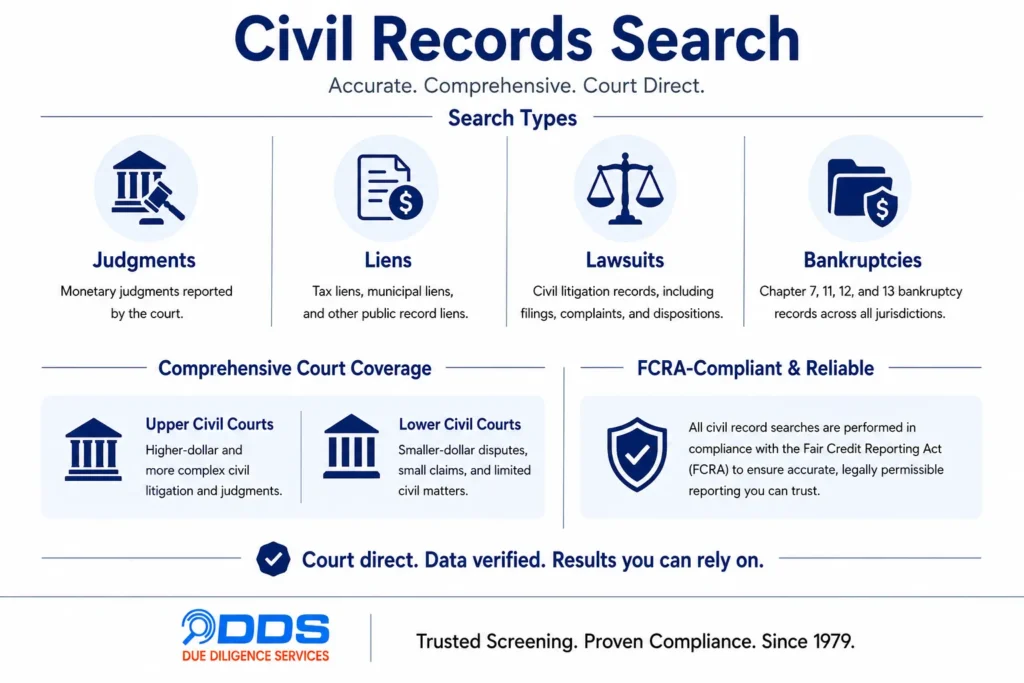
Upper and Lower Civil Court Coverage
Civil cases are handled at two court levels, and a thorough civil records search covers both:
Lower civil courts handle smaller-dollar disputes — small claims, lower-value judgments, and limited civil matters. The dollar thresholds vary by jurisdiction, but lower courts handle the high volume of everyday civil disputes.
Upper civil courts handle higher-dollar and more complex civil litigation — significant lawsuits, large judgments, and major civil proceedings.
A civil records search limited to only one level misses cases handled at the other. A pattern of small-claims judgments in lower court, or a single major judgment in upper court, could each be relevant — and a single-level search would miss one of them. DDS searches both upper and lower civil courts so the civil records search captures the complete picture.
Is a civil records search right for your roles?
A 20-minute consultation will help you determine which positions warrant a civil records search — and how to incorporate it into a compliant, role-appropriate screening program. No obligation, no charge.
Which Roles Need a Civil Records Search
A civil records search isn’t necessary for every position — but for certain roles, it surfaces information no other search can. It’s most valuable for:
– Executives and Senior Leadership — where a history of litigation or judgments may bear on judgment, financial stability, or reputational risk
– Financial Officers and Fiduciaries — where unpaid judgments, liens, or bankruptcy history may be directly relevant to handling company money
– Partners and Equity Stakeholders — where civil legal history matters to the partnership or ownership relationship
– Roles with Signing Authority — where the individual can legally bind the organization
– Positions Handling Significant Assets — where financial responsibility is central to the role
Whether a civil records search is appropriate for a given role depends on the position’s responsibilities and applicable legal limits. DDS helps determine where it adds value — and where it doesn’t — during the free consultation.
Civil Records and FCRA Compliance
Reporting civil records for employment purposes is governed by the Fair Credit Reporting Act (FCRA), and the rules around what can be reported and considered are specific and evolving. DDS complies with all FCRA regulations governing the civil records search — and evolves its practices as those regulations evolve.
Key FCRA considerations DDS applies to every civil records search:
– Permissible purpose and authorization. Civil records are reported only for employment purposes with proper candidate authorization on file.
– Accuracy. Reported civil records are confirmed to belong to the individual being screened, not a coincidental name match.
– Compliance review. As with every DDS report, the civil records search result passes through compliance review before delivery.
– Adverse action support. Pre-adverse and adverse action letter templates accompany reports where applicable, supporting the employer’s FCRA-compliant decision process.
Because employment law around civil records — particularly the use of bankruptcy and certain financial information — continues to evolve at the federal, state, and local levels, DDS keeps its civil records search practices current with the changing regulatory landscape.
Why Employers Choose DDS for Civil Records Searches
1. Complete civil coverage. Judgments, liens, lawsuits, and bankruptcies — the full range of civil court records, not a partial search.
2. Upper and lower courts. DDS searches both civil court levels so nothing is missed at either threshold.
3. Full FCRA compliance. DDS complies with all FCRA regulations governing civil records reporting and evolves as the regulations evolve.
4. Accurate, verified results. Civil records are confirmed to belong to the individual being screened, with compliance review before delivery.
5. Role-appropriate guidance. DDS helps determine which roles genuinely warrant a civil records search — no unnecessary upsell for positions that don’t need it.
6. 1–3 day turnaround. Civil records searches are typically returned within one to three days.
7. Operating since 1979. Decades of experience navigating the evolving rules around civil records reporting for employment.
Frequently Asked Questions
What does a civil records search include?
A DDS civil records search covers civil judgments, liens (including tax, mechanic’s, and judgment liens), civil lawsuits, and bankruptcy filings. It examines the non-criminal court history of an individual or entity — disputes between private parties — which a criminal records search would never surface.
How is a civil records search different from a criminal search?
A criminal records search looks at crimes prosecuted by the government. A civil records search looks at disputes between private parties — lawsuits, judgments, liens, and bankruptcies. The two systems capture entirely different information; a candidate can have a clean criminal record while carrying significant civil litigation or unpaid judgment history.
Does DDS search both upper and lower civil courts?
Yes. DDS conducts the civil records search across both upper and lower civil courts. Lower courts handle smaller-dollar and limited civil matters; upper courts handle higher-dollar and more complex litigation. Searching both levels ensures complete coverage — a single-level search would miss cases handled at the other.
Which roles should have a civil records search?
A civil records search is most valuable for executives, financial officers and fiduciaries, partners and equity stakeholders, roles with signing authority, and positions handling significant assets — anywhere financial responsibility, fiduciary duty, or legal exposure is central to the role. It isn’t necessary for every position.
Can bankruptcy be considered in a hiring decision?
Bankruptcy reporting and consideration for employment is governed by the FCRA and other federal, state, and local laws, with specific limits. DDS reports bankruptcy information within FCRA compliance and keeps its practices current as the regulations evolve. Whether and how an employer may consider it depends on the role and applicable law — an area where consulting employment counsel is advisable.
How does DDS stay FCRA-compliant on civil records?
DDS reports civil records only for employment purposes with proper authorization, confirms records belong to the individual being screened, runs compliance review before delivery, and provides adverse action letter templates where applicable. Because the rules around civil records reporting continue to evolve, DDS keeps its civil records search practices current with the changing regulatory landscape.
How accurate are civil records searches?
DDS confirms that reported civil records actually belong to the individual being screened rather than a coincidental name match. As with every DDS search, results pass through compliance review before delivery, so the employer receives verified, reportable information.
How long does a civil records search take?
A civil records search is typically returned within one to three days, depending on the courts involved and their access processes. Some courts provide records quickly; others require direct requests that take longer.
Ready to Add Civil Records to Your Screening Program?
A free consultation shows you how a civil records search fits your screening program — which roles need it, what it covers, and how DDS keeps it FCRA-compliant. No obligation, no charge.