
Drug Testing Kits
Instant, lab-based, and hair collection kits for locations a collection site can't reach — with laboratory confirmation where it counts. Trusted since 1979.
Instant, Lab-Based & Hair Kits
Built for Remote Locations
Lab Confirmation on Positives
Trusted Since 1979
What Are Drug Testing Kits?
Drug testing kits allow specimen collection to happen where the employee is, rather than requiring travel to a collection facility. For most employers with a collection site nearby, sending an employee to that site remains the simplest path. Drug testing kits exist for the situations where that isn’t practical.
The most common scenario is geography. An employer operating at a remote location — a rural facility, a field site, a plant far from any collection center — may face hours of travel for a single test. That’s a real cost in time and productivity, and after an accident it can also mean losing the testing window entirely.
Drug testing kits close that gap, provided one condition is met: someone at the location must be a certified employee qualified to administer the collection. Kits don’t remove the need for proper administration — they relocate it. DDS supplies the kits, and the on-site certified administrator conducts the collection following the required procedure.
The Types of Drug Testing Kits DDS Provides
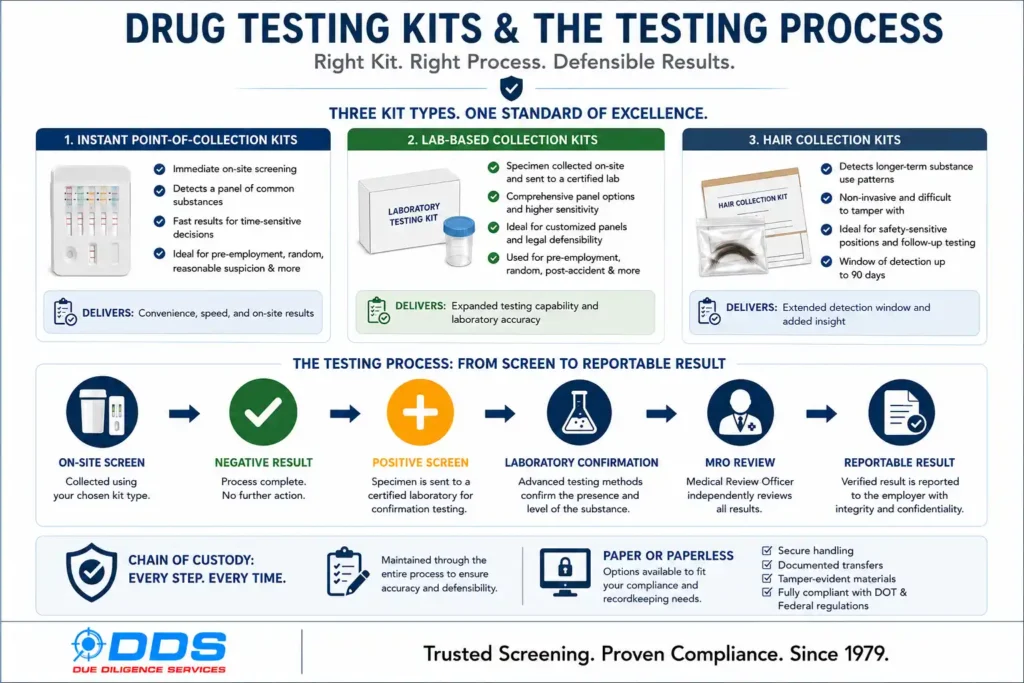
DDS provides the full range of drug testing kits, matched to what the situation requires:
Instant point-of-collection kits. These produce a preliminary screening result on site, within minutes. Certain instant devices now carry Department of Transportation approval for use as a screening test. Their value is speed — an immediate preliminary indication, which matters most in post-accident situations and where a rapid go/no-go decision is needed. What they produce is a screen, not a final result.
Lab-based collection kits. These are collection kits rather than testing devices. The specimen is collected on site using the kit and shipped to a SAMHSA-certified laboratory for full analysis. There is no on-site result — the outcome comes from the laboratory, with Medical Review Officer review, exactly as it would from a collection site.
Hair collection kits. Hair specimens are collected on site and sent to the laboratory. Hair testing offers a substantially longer detection window than urine, making it suited to situations where a broader pattern of use is the question rather than recent use.
Which of these drug testing kits fits depends on the testing circumstance, the regulatory status of the workforce, and what decision the employer needs to make. DDS advises on that rather than shipping a default kit.
Instant Results Are a Screen — Not a Final Answer
This is the most important thing to understand about instant drug testing kits, and the point employers most often get wrong.
An instant test produces a preliminary screen. A negative screen is generally sufficient to conclude the test. A positive screen is not a positive result — it is an indication that requires confirmation. Any positive screen should, and in regulated contexts must, be sent to a laboratory for confirmatory analysis.
The reason is accuracy. Screening technology is designed to be sensitive, which means it can flag specimens that full laboratory analysis subsequently clears. Legitimate prescription medications, cross-reacting compounds, and other factors can produce a preliminary positive that isn’t confirmed. Laboratory confirmatory analysis — followed by Medical Review Officer review, where the employee can explain a legitimate medical explanation — is what turns a screen into a defensible result.
An employer who terminates, suspends, or withdraws an offer on the strength of an unconfirmed instant screen is exposed on every front: the underlying result may not hold up, the process departs from accepted practice, and in a regulated context it violates the applicable rules outright.
DDS structures kit-based programs so this sequence is built in: instant screen on site, laboratory confirmation of any positive, MRO review, and only then a reportable result the employer can act on. The written drug testing policy should state this explicitly, so no supervisor has to make the call in the moment.
Testing at a location a collection site can't reach?
A 20-minute consultation determines whether drug testing kits fit your situation, which type suits your circumstances, and what your on-site administration and confirmation process needs to look like. No obligation, no charge.
Chain of Custody — Paper and Paperless
A specimen’s chain of custody is the documented record of who handled it, when, and under what conditions, from collection through analysis. Without an intact chain of custody, a result is challengeable no matter how sound the laboratory work behind it.
This matters more with drug testing kits than with site-based collection, because the collection happens outside a controlled collection facility. The documentation is what establishes that the specimen analyzed by the laboratory is the specimen collected from that employee, unaltered.
DDS supports both formats:
Paper chain of custody forms. The traditional multi-part form completed at collection and traveling with the specimen. Reliable everywhere, and the practical choice where connectivity is limited — which is often the case at exactly the remote locations that need kits.
Paperless chain of custody. Electronic completion at collection, reducing transcription errors and the rejected-specimen problem that comes from incomplete or illegible paperwork.
Either format satisfies the requirement when completed correctly. DDS recommends the one that fits the site’s conditions and trains the on-site certified administrator on completing it properly — because a kit-based program lives or dies on collection procedure and documentation.
Who Uses Drug Testing Kits
Drug testing kits are principally used by employers at remote locations who have a certified employee on site able to administer the collection. The pattern is consistent:
– Remote facilities and field operations — sites where the nearest collection center is impractically far
– Post-accident situations at distant locations — where the testing window is tight and travel would consume it
– Dispersed operations — organizations with sites spread across areas thinly served by collection facilities
– Programs needing on-site speed — where a preliminary screening result materially changes the immediate decision
The determining factor is usually the certified administrator. Without someone on site qualified to conduct the collection, drug testing kits aren’t the answer — and DDS will say so rather than ship kits that will produce unusable results. Where that person exists, kits turn an impractical testing situation into a workable one.
Frequently Asked Questions
What types of drug testing kits does DDS provide?
DDS provides instant point-of-collection kits, lab-based collection kits, and hair collection kits. Instant kits give a preliminary screening result on site. Lab-based and hair kits are collection kits — the specimen is collected on site and sent to a certified laboratory for analysis.
Is an instant positive result final?
No. An instant test is a preliminary screen. A positive screen should, and in regulated contexts must, be sent to a laboratory for confirmatory analysis, followed by Medical Review Officer review. Acting on an unconfirmed instant positive exposes an employer on every front — the result may not hold up, and in a regulated context it violates the applicable rules.
Why can a preliminary screen be positive when the lab result isn't?
Screening technology is designed to be sensitive, so it can flag specimens that full laboratory analysis subsequently clears. Legitimate prescription medications and cross-reacting compounds can produce a preliminary positive. Laboratory confirmation and MRO review are what resolve this and produce a defensible result.
Are instant tests DOT approved?
Certain instant devices now carry Department of Transportation approval for use as a screening test. That approval applies to their use as a preliminary screen — it does not make an instant positive a final result. Confirmatory laboratory analysis of any positive screen remains required.
Who can administer a kit collection?
A certified employee at the location, qualified to conduct the collection and trained on the required procedure and chain of custody documentation. Kits relocate the collection; they don’t remove the need for proper administration. Without a qualified administrator on site, kits generally aren’t the right solution.
What chain of custody options are available?
Both paper and paperless chain of custody forms. Paper forms are reliable anywhere and practical where connectivity is limited, which is common at remote sites. Paperless completion reduces transcription errors and specimens rejected for incomplete or illegible paperwork. Either satisfies the requirement when completed correctly.
When should we use hair collection kits instead of urine?
Hair testing offers a substantially longer detection window than urine, so it suits situations where the question is a broader pattern of use rather than recent use. Urine remains the required specimen type in federally regulated testing. DDS advises on which fits the circumstance and regulatory status.
Testing That Reaches Every Location
A free consultation covers which drug testing kits fit your sites, how on-site administration and chain of custody should work, and how laboratory confirmation keeps every result defensible. No obligation, no charge.