
Alcohol Screening
Breath, EtG, and blood testing administered by certified technicians — to DOT standards where they apply. Trusted since 1979.
Alcohol screening differs from drug testing in one crucial respect: it measures current impairment, not past use. A breath alcohol test tells an employer whether someone is under the influence right now, which is exactly what matters after an accident or when a supervisor observes impairment on the job. DDS provides alcohol screening through breath alcohol testing, EtG urine testing, and blood testing, administered by certified technicians and conducted to Department of Transportation standards wherever DOT rules apply.
Certified BAT Technicians
DOT Threshold Compliance
Trusted Since 1979
What Is Alcohol Screening?
Alcohol screening determines whether an employee has alcohol in their system, and at what concentration. Unlike drug testing — which detects substances used days or weeks earlier — alcohol screening is fundamentally about the present. Alcohol clears the body quickly, so a positive result generally indicates current or very recent consumption.
That distinction shapes how alcohol screening is used. It is the right tool immediately after a workplace accident, when a supervisor has reasonable suspicion of on-duty impairment, and as part of a random testing program in regulated industries. It is a poor tool for detecting a pattern of off-duty drinking, and employers who expect it to do that are using the wrong instrument.
DDS provides alcohol screening across the full range of methods, matched to the circumstance and to the regulatory standards that apply to the employer.
Alcohol Screening Methods
DDS provides three alcohol screening methods, each suited to different circumstances:
Breath Alcohol Testing (BAT). The standard method for workplace alcohol screening and the required method under DOT rules. A breath alcohol test measures Breath Alcohol Concentration directly, produces results on the spot, and is administered by a certified Breath Alcohol Technician using an approved evidential breath testing device. Its immediacy is what makes it the right tool for post-accident and reasonable-suspicion situations.
EtG Urine Testing. Ethyl glucuronide is a metabolite that remains detectable well after alcohol itself has cleared the body — extending the detection window considerably beyond a breath test. EtG alcohol screening is used where the question is recent consumption rather than present impairment, such as monitoring abstinence in a return-to-duty or follow-up context. EtG detects prior consumption; it does not establish current impairment.
Blood Testing. Blood alcohol testing measures concentration directly in the bloodstream and is used in specific circumstances where that level of precision is warranted.
Which method fits depends on the question being asked. DDS advises on that during program design rather than defaulting to a single method for every situation.
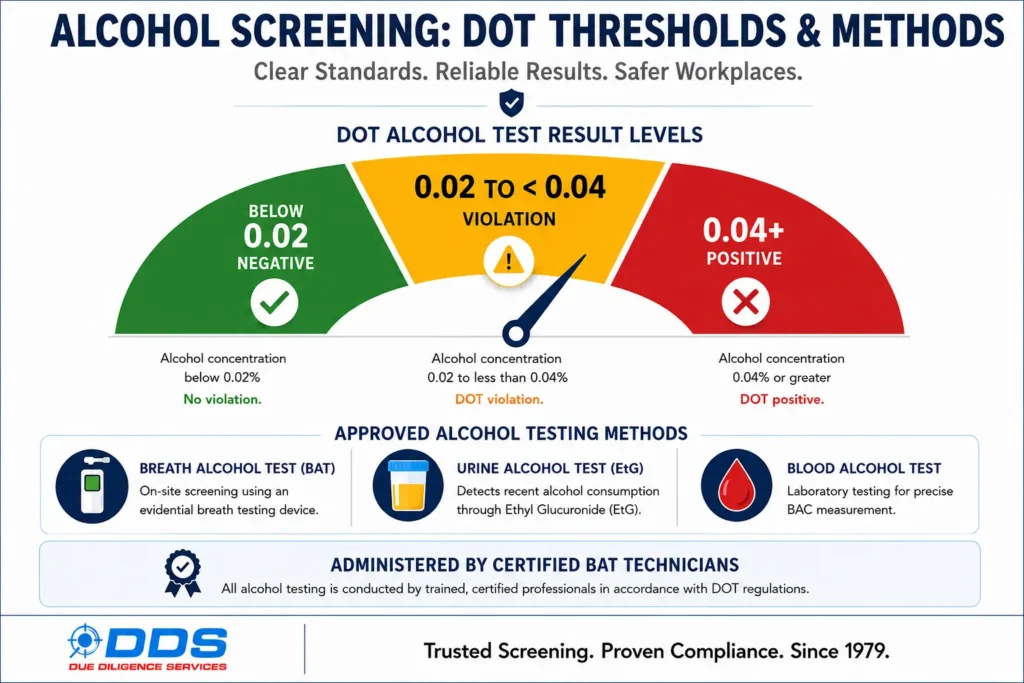
DOT Alcohol Screening Thresholds
For federally regulated employers, alcohol screening results are interpreted against thresholds set by Department of Transportation standards. There are three outcome bands:
Below 0.02 — Negative. The employee may remain on duty. No further action is required.
0.02 to below 0.04 — Violation. This is not a negative result. The employee must be immediately removed from safety-sensitive duty for a minimum period specified by the applicable regulation, and may not return until a subsequent test shows a concentration below 0.02.
0.04 and above — Positive. A positive alcohol test. The employee is immediately removed from safety-sensitive functions and may not return to duty until completing the return-to-duty process, which involves evaluation by a Substance Abuse Professional and a verified negative return-to-duty test.
The middle band is where employers most often make mistakes. A result between 0.02 and 0.04 is frequently treated as “passing” because it falls under the positive threshold — but under DOT rules it is a violation requiring immediate removal from safety-sensitive duty. DDS makes sure client programs handle all three bands correctly, and that the required actions are documented in the drug and alcohol testing policy before a result ever arrives.
Does your program handle every result band correctly?
A 20-minute consultation reviews your alcohol screening methods, thresholds, and removal-from-duty procedures — including the 0.02 to 0.04 band employers most often get wrong. No obligation, no charge.
When Alcohol Screening Is Required
Alcohol screening applies across the full range of testing circumstances:
Post-Accident. Following a qualifying workplace accident, alcohol screening establishes whether impairment was a factor. Because alcohol clears quickly, post-accident testing is time-sensitive — regulated employers face specific windows, and a delayed test loses evidentiary value.
Reasonable Suspicion. When a trained supervisor observes specific, articulable indicators of impairment, alcohol screening confirms or rules it out. The observation must be documented, and supervisors should be trained to recognize and record what they saw rather than relying on impression.
Random. Regulated employers must include alcohol testing in their random program at the annual rate their agency sets. Under FMCSA, the current random alcohol rate is 10% of average driver positions. Non-regulated employers may include alcohol screening in random programs by choice.
Return-to-Duty and Follow-Up. Employees returning after a violation undergo alcohol screening before resuming safety-sensitive duty, followed by an unannounced follow-up testing schedule.
Pre-Employment. Some employers include alcohol screening in pre-employment testing, subject to the rules applicable to their industry and jurisdiction.
Each circumstance should be defined in the written policy — when testing occurs, who authorizes it, and what happens next.
Certified Technicians and Proper Administration
Alcohol screening results are only defensible if the testing was administered correctly, which is why the technician matters as much as the device.
DDS breath alcohol testing is conducted by certified Breath Alcohol Technicians (BATs) trained to the applicable standard and using approved evidential breath testing equipment. The technician follows a prescribed procedure: verifying the device, conducting the screening test, and — where the screening result requires it — performing a confirmation test after the mandated waiting period, with the confirmation result governing.
This procedural discipline is what stands up if a result is challenged. An alcohol screening result produced by an uncertified administrator, on unverified equipment, or without the required confirmation sequence is vulnerable — regardless of what the number said. DDS’s collection network and certified technicians exist so that every result the employer acts on was produced correctly.
Frequently Asked Questions
What alcohol screening methods does DDS provide?
DDS provides breath alcohol testing (BAT), EtG urine testing, and blood testing. Breath alcohol testing is the standard for workplace use and the required method under DOT rules. EtG extends the detection window beyond current impairment. Blood testing is used where that level of precision is warranted.
What do the DOT alcohol thresholds mean?
Under Department of Transportation standards there are three bands. Below 0.02 is negative and the employee may remain on duty. From 0.02 to below 0.04 is a violation requiring immediate removal from safety-sensitive duty for a minimum period, with return permitted only after a subsequent test below 0.02. A result of 0.04 or above is positive, requiring removal and completion of the return-to-duty process.
Is a result between 0.02 and 0.04 a pass?
No. This is the most common misunderstanding in alcohol screening. Although it falls below the 0.04 positive threshold, a result from 0.02 to below 0.04 is a violation under DOT rules and requires immediate removal from safety-sensitive duty. Treating it as a pass is a compliance failure.
How is EtG testing different from a breath test?
A breath test measures current alcohol concentration and therefore current impairment. EtG detects ethyl glucuronide, a metabolite that remains present well after alcohol itself has cleared, so it identifies recent consumption over a longer window. EtG does not establish current impairment — the two tests answer different questions.
When is alcohol screening required?
Post-accident, on reasonable suspicion, as part of random testing for regulated employers, and for return-to-duty and follow-up testing after a violation. Some employers also include it pre-employment. Each circumstance should be defined in the written testing policy.
Who is qualified to conduct a breath alcohol test?
A certified Breath Alcohol Technician (BAT), trained to the applicable standard and using approved evidential breath testing equipment, following the prescribed screening and confirmation procedure. A result produced by an uncertified administrator or without the required confirmation sequence is vulnerable to challenge.
Why is post-accident alcohol testing time-sensitive?
Alcohol clears the body quickly, so evidentiary value degrades with delay. Regulated employers face specific windows within which post-accident alcohol screening must be attempted, and testing outside those windows may not be usable. Post-accident procedures should be documented in advance so no one is deciding what to do in the moment.
Alcohol Screening Done Correctly
A free consultation reviews your methods, thresholds, and procedures — so every alcohol screening result your organization acts on was produced correctly and handled compliantly. No obligation, no charge.