
Drug Testing Policy: First Things First
Before the panels, the specimens, and the collection sites — the drug testing policy that makes everything else defensible. Trusted since 1979.
A drug testing policy is the first thing an employer needs — and the thing most often skipped. The common mistake isn’t choosing the wrong panel or the wrong lab; it’s launching testing with no accompanying policy, plan, or protocol behind it. Whether your workforce is federally regulated (where the rules are dictated to you) or non-regulated (where you have choices to make), a written drug testing policy is the foundation every test, every decision, and every adverse action stands on. DDS helps employers build that drug testing policy first, then the program.
Policy First, Testing Second
Regulated or Non-Regulated
DDS Consults, You Decide
Trusted Since 1979
Since 1979 · 1M+ checks a year · 94% client retention · PBSA founding member
Why a Drug Testing Policy Comes First
Testing without a written drug testing policy creates problems on every front:
– Legal exposure. Without a policy defining who is tested, when, and what happens on a positive result, every adverse action taken on a test result is vulnerable to challenge as arbitrary or inconsistent.
– Inconsistent application. Supervisors improvise — one employee is sent for a reasonable-suspicion test, another in identical circumstances isn’t. Inconsistency is where claims begin.
– No employee notice. Employees must know the program exists, what it covers, and what the consequences are. A test an employee never knew was possible is a dispute waiting to happen.
– No protocol for results. What happens on a positive? Termination, referral, second chance? Without a predetermined protocol, those decisions get made ad hoc, under pressure, differently each time.
A drug testing policy solves all four at once. It defines the scope, the circumstances, the substances, the procedures, and the consequences — before anyone is tested. That’s why DDS treats the drug testing policy as step one, not paperwork to catch up on later.
Why Employers Test
A drug testing policy needs a clear rationale behind it. The justification is concrete:
Safety. Impairment on the job endangers the impaired employee, coworkers, and the public — the primary reason federal rules mandate testing in regulated industries.
Liability. An employer who could have known about impairment and didn’t act carries real exposure: workers’ compensation claims, negligence liability, and the cost of preventable accidents.
Productivity and reliability. Substance abuse correlates with absenteeism, turnover, errors, and workplace conflict.
Deterrence. A known, consistently applied policy deters use before it starts — often the most valuable effect, and the least visible.
Documenting this rationale inside the drug testing policy matters: a policy that states why it exists and what it protects is far more defensible than one that simply asserts the employer’s right to test.
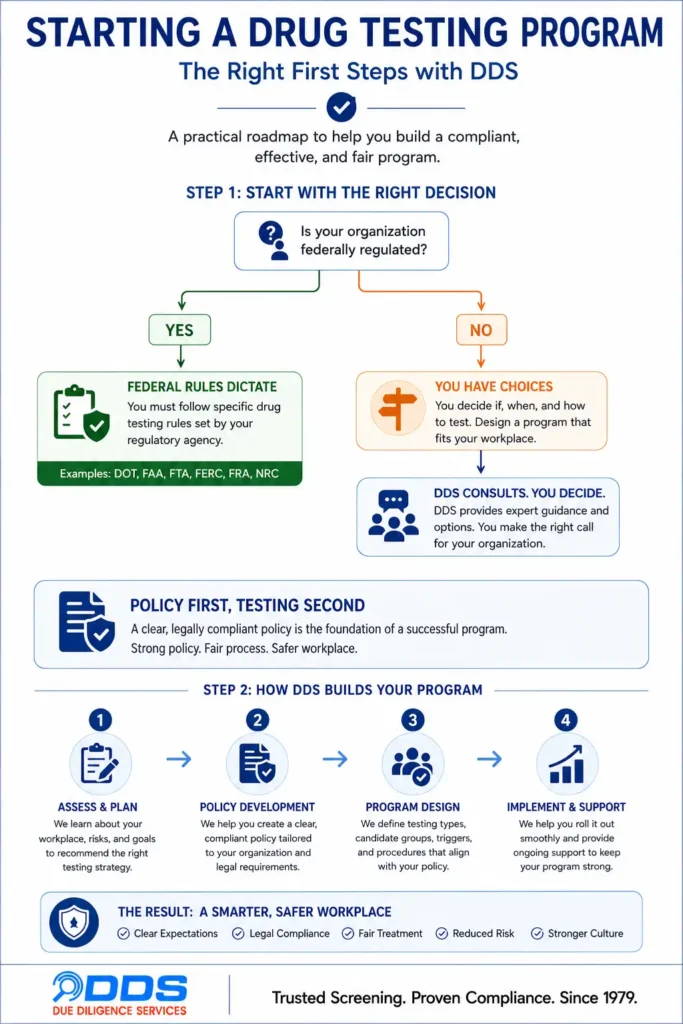
Regulated or Non-Regulated? The Question That Shapes Your Policy
Every drug testing policy decision flows from one question: is your workforce federally regulated?
Regulated employers have no choices. If you employ CDL drivers under FMCSA, or workers under other DOT agencies (FAA, FRA, FTA, PHMSA, USCG), federal rules dictate the substance panel, the specimen type, the testing circumstances, the random rates, the MRO review, and the documentation. There is nothing to design — only to implement correctly. The drug testing policy for regulated roles documents and operationalizes those federal requirements.
Non-regulated employers have choices. Everyone else decides: which panel, which specimen type, which testing circumstances, which roles are covered. Those choices should reflect the industry, risk profile, state law, and goals — and this is exactly where DDS comes in as a consultant. DDS provides the expert guidance and options; the employer makes the call, and the resulting drug testing policy reflects their actual situation rather than a vendor’s template.
Many employers are mixed — some roles regulated, some not. The drug testing policy has to handle both correctly, which is one of the most common places a do-it-yourself policy goes wrong.

“It is with great pleasure to write a recommendation for DDS and its phenomenal Team! They have always proven to be responsive, helpful, efficient, trustworthy and competent! We have been utilizing their services since 1990 and look forward to continuing our relationship for many years to come!”
Holly
Pavilion Agency, Inc.
No policy yet? That's exactly the right time to talk.
A 20-minute consultation establishes whether you’re regulated or non-regulated, what your drug testing policy must include, and what has to be in place before the first test is run. No obligation, no charge.
What a Drug Testing Policy Should Include
A complete drug testing policy addresses, at minimum:
– Scope — which employees, roles, and locations are covered, and how regulated and non-regulated roles are distinguished
– Testing circumstances — pre-employment, random, post-accident, reasonable suspicion, return-to-duty, and follow-up
– Substances tested — the panel, and any expanded testing
– Procedures — collection process, chain of custody, laboratory, and MRO review
– Consequences — what happens on a positive result, on a refusal, and on a diluted or adulterated specimen
– Employee notice and acknowledgment — how employees are informed and how that’s documented
– State-law compliance — the requirements that vary by jurisdiction, including marijuana handling
DDS helps employers assemble each of these elements into a coherent, compliant drug testing policy — then builds the testing program on top of it.
How DDS Builds Your Drug Testing Policy and Program
1. Assess and classify. DDS learns your workplace, risks, and goals, and establishes whether roles are regulated, non-regulated, or mixed.
2. Policy development. DDS helps create a clear, compliant drug testing policy tailored to your organization and legal requirements — the foundation everything else stands on.
3. Program design. Testing types, covered groups, triggers, and procedures are defined to align with the policy — federal requirements for regulated roles, consultative design for non-regulated ones.
4. Implement and support. Collection network, SAMHSA-certified laboratories, and MRO review connected through one provider, with ongoing live support. New clients are typically up and running within a week.
For the mechanics of rolling out and administering the program itself, see [Implementing a Drug Testing Program].
Frequently Asked Questions
What is a drug testing policy?
A drug testing policy is the written document defining who is tested, under what circumstances, for which substances, using what procedures, and with what consequences. It’s the foundation a workplace testing program stands on — establishing employee notice, consistent application, and a defensible basis for any action taken on a result.
Do I need a policy before I start testing?
Yes — and skipping it is the most common mistake employers make. Testing with no accompanying policy, plan, or protocol creates legal exposure, inconsistent application, no employee notice, and ad hoc decisions on positive results. The drug testing policy comes first; testing comes second.
What should a drug testing policy include?
Scope (who’s covered), testing circumstances (pre-employment, random, post-accident, reasonable suspicion, return-to-duty, follow-up), substances tested, procedures including chain of custody and MRO review, consequences of a positive or refusal, employee notice and acknowledgment, and state-law compliance requirements.
Does my policy differ if I'm federally regulated?
Significantly. Regulated employers have the panel, specimen type, testing circumstances, random rates, and review process dictated by federal rules — the drug testing policy documents and operationalizes those requirements. Non-regulated employers make those choices themselves, with DDS consulting on the right combination.
Do state laws affect my drug testing policy?
Yes, considerably — particularly for non-regulated employers. States vary on permitted testing, marijuana handling, and procedural requirements. A drug testing policy written for one state may not transfer cleanly to another, which is part of the consultative design DDS provides.
How quickly can we go from policy to testing?
Once the drug testing policy and protocol are in place, implementation is fast — DDS has new clients up and running within a week, with collection sites, SAMHSA-certified laboratories, and MRO review connected through a single provider.
Start With the Policy. Build the Program on Top.
A free consultation establishes your classification, drafts what your drug testing policy needs to cover, and lays out the program that fits — before the first test is ever run. No obligation, no charge.