
Statewide and County Criminal Searches
Direct county court searches and current statewide repository checks — we only use repositories with the most up-to-date county data. Trusted since 1979.
Statewide and county criminal searches are the foundation of an accurate criminal background check. County searches go directly to the courthouse — the original source of the record. Statewide searches query a state repository that covers all counties in one search, but only when that repository is current. DDS performs statewide and county criminal searches with a strict standard: we only use state repositories that have the most current information uploaded from their counties.
Direct County Court Searches
Current Statewide Repositories Only
1–2 Day County Turnaround
Transparent, Itemized Fees
County Searches vs. Statewide Searches — What's the Difference?
Both are criminal record searches, but they work differently and serve different purposes within a background check.
County criminal searches go directly to the courthouse where a case was handled — part of the state court system that handles the vast majority of criminal cases in the U.S. The county court is the original source of the record — the most accurate and authoritative place to confirm a criminal case. County searches are the gold standard for accuracy because nothing is lost in translation between the court and an intermediary database.
Statewide criminal searches query a state-level repository that aggregates records from all the counties within that state. The advantage is breadth: a single statewide search can cover every county in the state at once. The catch is currency — a statewide repository is only as good as the data the counties upload to it, and that varies significantly from state to state.
This is where DDS applies a strict standard. We use statewide and county criminal searches strategically: a statewide repository is recommended only when it reliably contains current, complete data from its counties. When it doesn’t, we go directly to the county.
Our Statewide Repository Standard
Not all statewide repositories are created equal. Some states maintain repositories that are updated promptly and completely from every county. Others lag — counties may upload records weeks, months, or even longer after a case is resolved, leaving gaps that make a statewide-only search unreliable.
DDS applies a clear rule: we only use state criminal repositories that have the most current information uploaded from their counties. Every statewide repository in our active list is one we’ve confirmed to be reliable. When a state’s repository doesn’t meet that standard — whether because of update lag or incomplete county participation — we recommend a direct county search instead.
This is the difference between a screening provider that simply runs whatever statewide database is cheapest and a provider that knows which repositories are trustworthy and which aren’t. A statewide search that misses recent records because the repository is stale is worse than no statewide search at all — it creates false confidence. DDS won’t put a client in that position.
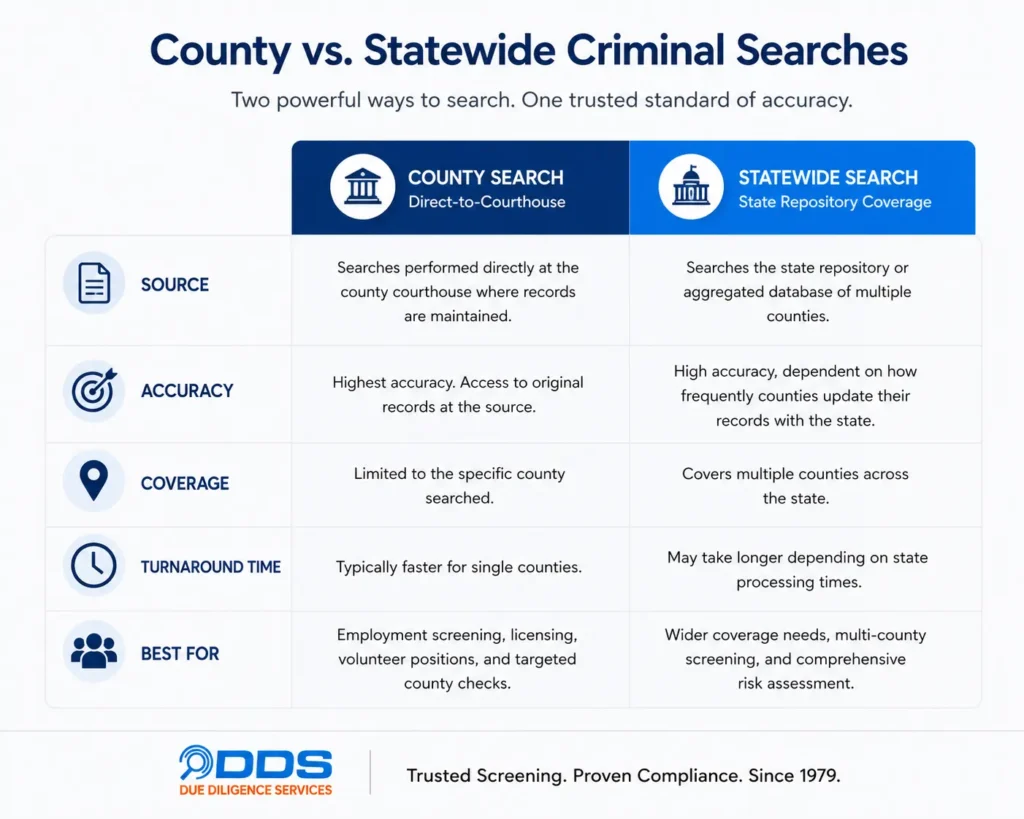
Direct County Court Searches
Within statewide and county criminal searches, when a direct county search is the right call — either because no reliable statewide repository exists, or because the case requires courthouse-level confirmation — DDS goes straight to the source.
Most county searches return results within 1 to 2 days. The timeline depends on the specific county’s process:
– Online-accessible counties return results quickly, often same-day to next-day
– Counties requiring a Court Clerk request take longer, because access is only available by submitting a request directly to the clerk’s office, and the clerk’s response time determines turnaround
Some counties restrict access entirely to manual Court Clerk requests, which can occasionally delay a result. DDS knows which counties operate this way and sets accurate expectations during the consultation — no surprises, no vague “pending” status with no explanation. As with all DDS criminal searches, if a county is slow to respond, we follow our persistence protocol rather than closing out the case prematurely.
Build a county and statewide search strategy that's actually accurate
A 20-minute consultation will show you how DDS decides between statewide and county searches for each jurisdiction — and how we keep your criminal background program both thorough and current. No obligation, no charge.
How DDS Decides: Statewide, County, or Both
The decision between statewide and county criminal searches is made jurisdiction by jurisdiction, based on data quality and the candidate’s history:
1. Is there a reliable statewide repository? If the state maintains a current, complete repository, a statewide search efficiently covers all counties at once.
2. If not, which counties matter? Where no reliable statewide repository exists, DDS identifies the specific counties relevant to the candidate — based on residency history and other address data surfaced through the SSN trace and National Crime Index — and conducts direct county searches there.
3. Does the role warrant both? For higher-risk or higher-responsibility positions, DDS may recommend layering a statewide search with targeted county searches for maximum coverage.
This jurisdiction-by-jurisdiction logic is what separates a thoughtful criminal background program from a generic package. DDS recommends the right combination of statewide and county criminal searches for each candidate — not a one-size-fits-all template that over-searches some and under-searches others.
Fees and Access Transparency
Some state repositories and counties charge access fees to retrieve records. DDS handles these transparently. DDS conducts these searches as an FCRA-compliant Consumer Reporting Agency.
We maintain an updated fee schedule for all state repositories and for the counties that charge access fees. This list is kept current and updated as needed, so the fees a client sees reflect what the jurisdiction actually charges. Any access fee is passed through as a clearly itemized line item — never marked up, never buried in the base price.
For the counties where access is available only by request to the Court Clerk, DDS explains the potential for additional time and any associated fee up front, so the client knows what to expect before the search begins. Transparent fees apply across all our statewide and county criminal searches.
Why Employers Choose DDS for Statewide and County Criminal Searches
1. Current repositories only. DDS uses statewide repositories only when they contain the most current data uploaded from their counties. No stale databases creating false confidence.
2. Direct-to-courthouse county searches. When county-level accuracy is needed, DDS goes straight to the source court record — the most authoritative result available.
3. Jurisdiction-by-jurisdiction logic. DDS recommends the right combination of statewide and county criminal searches for each candidate based on data quality and history, not a generic package.
4. 1–2 day county turnaround. Fast results, with honest expectations set for counties that require manual Court Clerk requests.
5. Transparent, itemized fees. An updated fee schedule for every repository and county, with access fees passed through exactly as charged.
6. The persistence protocol. When a county is slow to respond, DDS investigates rather than closing the case prematurely — clients get answers, not excuses.
7. Operating since 1979. Decades of knowing which repositories are reliable, which counties require manual access, and how to build an accurate, current criminal search program.
Frequently Asked Questions
What's the difference between a statewide and a county criminal search?
A county criminal search goes directly to the courthouse where a case was handled — the original, most accurate source. A statewide criminal search queries a state repository that aggregates records from all counties, covering the whole state in one search, but only as current as the data counties upload to it. DDS uses statewide and county criminal searches strategically based on which is reliable for each jurisdiction.
Are statewide repositories always reliable?
No. Statewide repositories vary significantly in how promptly and completely counties upload records. Some are current and complete; others lag. DDS only uses state repositories that have the most current information uploaded from their counties — every statewide repository in our active list is one we’ve confirmed to be reliable. When a repository doesn’t meet that standard, we recommend a direct county search.
How long does a county criminal search take?
County searches go directly to the courthouse — the most accurate source. Statewide searches query a state repository that coverMost county searches return results within 1 to 2 days. Online-accessible counties are often faster; counties that require a request to the Court Clerk take longer because the clerk’s response time determines turnaround. DDS sets accurate expectations for each county during the consultation.s all counties in that state, where a reliable one exists. Federal searches query a completely separate database covering federal crimes like fraud and interstate offenses. DDS layers these based on the candidate’s history and the role.
What Is a Pre-Employment Background Check?
Why would DDS recommend a county search over a statewide search?
When a state has no reliable statewide repository, or when the repository isn’t current enough to trust, DDS recommends direct county searches for the jurisdictions relevant to the candidate. County searches go to the source court record, so they don’t depend on the upload timeliness that can make statewide repositories unreliable.
How does DDS decide which counties to search?
DDS identifies relevant counties based on the candidate’s residency history and address data surfaced through the SSN trace and National Crime Index, focusing county searches where the candidate has actually lived within the applicable search timeframe.
Are there extra fees for these searches?
Some state repositories and counties charge access fees. DDS maintains an updated fee schedule for all repositories and applicable counties, and passes any access fee through as a clearly itemized line item — never marked up or hidden. The fee schedule is kept current and updated as needed.
What happens with counties that only allow Court Clerk requests?
Some counties restrict record access to manual requests submitted directly to the Court Clerk. This can occasionally delay a result, since the clerk’s response time governs turnaround. DDS knows which counties operate this way, explains the potential delay up front, and follows its persistence protocol rather than closing the case prematurely.
Should I run both a statewide and county search?
For higher-risk or higher-responsibility roles, layering a statewide search with targeted county searches gives maximum coverage. DDS recommends the right combination of statewide and county criminal searches for each candidate based on the role, the candidate’s history, and the data quality in each relevant jurisdiction.
Ready for Statewide and County Criminal Searches Done Right?
A free consultation shows you how DDS builds an accurate statewide and county criminal search strategy — current repositories, direct county access, and honest turnaround expectations. No obligation, no charge.