
Sanction Registries Screening Services
OIG, SAM, GSA, State Medicaid, FDA Debarment, OFAC, and international sanctions screening — including a dedicated Healthcare Sanctions Package. Trusted since 1979.
Sanction registries screening protects employers from one of the most expensive hiring mistakes possible: hiring or paying someone the federal government has formally excluded from participation in regulated programs. For healthcare employers, hiring an OIG-excluded individual can void Medicare and Medicaid reimbursement on that person’s entire scope of work. For federal contractors, hiring a SAM-debarred vendor can cost the contract. DDS screens against the full set of sanction registries that matter — federal, state, and international — and bundles the healthcare-specific lists into a single Healthcare Sanctions Package.
Healthcare Sanctions Package
Federal + 50-State Coverage
International OFAC + EU + UN + UK
Compliance-Critical Screening
What Are Sanction Registries?
Sanction registries are official government lists of individuals and entities that have been excluded, debarred, or otherwise prohibited from participating in specific federal programs, government contracting, healthcare reimbursement, financial transactions, or international trade. Each registry has its own scope, its own authority, and its own consequences for an employer that hires or contracts with someone on the list.
For employers in regulated industries — healthcare, federal contracting, financial services, defense, and others — screening candidates and vendors against the relevant sanction registries is not a “nice to have.” It’s a compliance requirement, and the cost of missing a hit can be severe:
– A healthcare provider that bills Medicare or Medicaid for services performed by an OIG-excluded individual can be forced to repay every dollar plus penalties
– A federal contractor that hires a SAM-debarred subcontractor can lose the contract
– A financial institution that processes a transaction for an OFAC-sanctioned individual can face significant regulatory penalties
DDS sanction registries screening searches every list that matters for the candidate’s role and your industry.
Which Sanction Registries DDS Screens
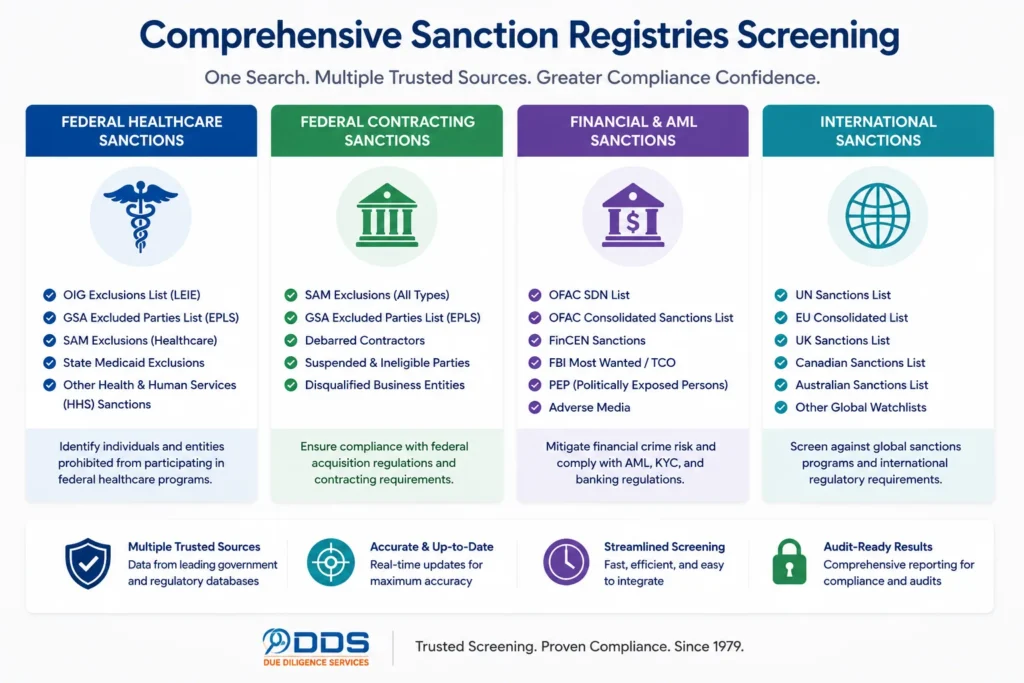
DDS has access to and searches the full set of sanction registries used in U.S. employment and vendor screening:
Federal Healthcare Sanctions
– OIG LEIE* (HHS Office of Inspector General — List of Excluded Individuals and Entities)
– SAM.gov (System for Award Management — includes the former EPLS exclusion data)
– GSA Excluded Parties List
– State Medicaid Exclusion Lists (each of the 50 states maintains its own — DDS searches all relevant state lists for healthcare clients)
– FDA Debarment List (individuals debarred from drug development and FDA-regulated industries)
International Sanctions and OFAC Screening
– OFAC SDN List (Specially Designated Nationals — primary U.S. sanctions list)
– OFAC Consolidated Sanctions (additional sectoral and non-SDN sanctions)
– PEP screening (Politically Exposed Persons — relevant for financial services and global compliance)
– EU Consolidated Sanctions List
– UN Security Council Consolidated Sanctions List
– UK HM Treasury Consolidated Sanctions List
Federal Contracting
– GSA SAM.gov debarment and exclusion records, used for federal contractor compliance under FAR
Each sanction list has its own search methodology, identifier rules, and match logic. DDS knows which lists matter for each industry, which to bundle, and which to deprioritize when a client’s roles don’t trigger them.
The DDS Healthcare Sanctions Package
For healthcare employers — hospitals, health systems, healthcare staffing agencies, long-term care facilities, physician groups, pharmacies, durable medical equipment providers, and any organization that bills Medicare or Medicaid — sanction screening is non-optional. The Centers for Medicare and Medicaid Services (CMS) requires healthcare employers to screen against federal exclusion lists before hiring and on an ongoing basis. Failing to do so can result in significant False Claims Act exposure.
DDS bundles the healthcare-specific sanction registries into a single Healthcare Sanctions Package that includes:
– OIG LEIE — the primary federal healthcare exclusion list
– SAM.gov — federal program exclusions
– State Medicaid Exclusion Lists — all 50 state-level Medicaid exclusion databases
A healthcare candidate or vendor cleared through this package has been screened against the three federal-and-state list categories that drive virtually all healthcare exclusion compliance risk. The package is priced as a bundle and runs as a single search workflow.
For roles with international scope — for example, healthcare staffing agencies placing international clinicians, or pharmaceutical companies operating across borders — DDS can layer OFAC and international sanctions screening on top of the Healthcare Sanctions Package as needed.
OFAC and International Sanctions Screening
For employers in financial services, international trade, defense, government contracting, and any business with global counterparties, OFAC and international sanctions screening is a core compliance requirement under U.S. and international law.
DDS screens against:
– OFAC SDN List — the primary U.S. Treasury list of sanctioned individuals, entities, vessels, and aircraft
– OFAC Consolidated Sanctions — non-SDN lists including the Sectoral Sanctions Identifications List and other targeted programs
– PEP screening — Politically Exposed Persons databases used by financial institutions and AML-compliant organizations
– EU Consolidated Sanctions — European Union sanctions enforcement list
– UN Security Council Sanctions — global UN sanctions consolidated list
– UK HM Treasury Sanctions — United Kingdom sanctions list
OFAC and international sanctions screening uses fuzzy matching, alias resolution, and identifier cross-referencing to surface potential hits where the candidate’s exact name doesn’t appear but a known alias, transliteration, or related entity does. DDS interprets the match results before reporting — false positives are surfaced for verification rather than reported as confirmed hits, protecting the client from acting on inaccurate matches.
Not sure which sanction registries apply to your roles?
A 20-minute consultation walks you through which sanction registries matter for your industry — healthcare, federal contracting, financial services, or international — and how DDS structures the screening package. No obligation, no charge.
Data Source and Update Frequency
A point of honesty that distinguishes DDS from some providers: DDS has access to these sanction databases. We do not maintain them.
Each sanction registry is maintained by its issuing authority — OIG maintains the LEIE, OFAC maintains the SDN List, each state Medicaid program maintains its own exclusion list, and so on. These authorities update their lists on their own schedules. When DDS searches a sanction registry, we query the source — getting current data from the authoritative list at the time of the search.
This matters because some providers imply they “monitor” or “maintain” sanction databases — language that suggests a level of database ownership that isn’t true. DDS’s approach is more honest and operationally more reliable: we go to the source authority for every search, and the data we report is whatever the source had at the time we queried it. No stale internal copies, no claims of database stewardship we don’t actually do.
For employers who want sanction registries screening on an ongoing basis — for example, monthly screening of an existing employee population — the screening can be re-run at any frequency the client chooses, and each re-run pulls fresh data from the source authorities.
Ongoing Sanction Screening
Continuous real-time monitoring of sanction registries — where the employer is alerted automatically the moment a current employee appears on a list — is not a service DDS markets, because the regulatory and technical infrastructure for true real-time alerting across all relevant lists isn’t consistent enough across registries to make the claim honest.
What DDS offers instead is periodic re-verification at the frequency the client chooses:
– Monthly re-screening for healthcare clients (a common cadence for Medicaid/OIG compliance programs)
– Quarterly re-screening for federal contractors maintaining SAM compliance
– Annual re-screening for general workforce sanction screening
– Custom schedules for specific high-risk roles
For each re-screening cycle, DDS runs the same source-direct query process and delivers an updated report. If a previously-clear employee now appears on a sanction list, the report surfaces it — and the employer can take appropriate action under their internal compliance policy.
The employer can also request an ad-hoc sanction registries re-check on any individual at any time. Unlike scheduled programs, ad-hoc re-checks don’t require an ongoing monitoring contract.
Industries That Require Sanction Screening
Sanction registries screening is essential for any organization in a regulated industry, but it’s particularly critical for these:
– Healthcare and Healthcare Staffing — OIG, SAM, State Medicaid Exclusion Lists are required for any organization billing federal healthcare programs. Hospitals, health systems, nursing homes, healthcare staffing agencies, physician practices, pharmacies, DME providers, and home health agencies all need this screening.
– Federal Contractors — SAM and GSA exclusion screening required under FAR for federal contractors and their subcontractors.
– Financial Services — OFAC SDN, OFAC Consolidated, and PEP screening required under BSA/AML programs for banks, credit unions, broker-dealers, money services businesses, and other financial institutions.
– Pharmaceutical and Life Sciences — FDA Debarment screening for individuals involved in drug development, manufacturing, and FDA-regulated processes.
– Defense and Aerospace — OFAC and international sanctions screening for contractors with global operations or export-controlled work.
– Multinational Employers — OFAC, EU, UN, and UK sanctions screening for any organization hiring or doing business across international borders.
Why Employers Choose DDS for Sanction Registries Screening
1. Full database coverage. OIG, SAM, GSA, all 50 State Medicaid lists, FDA Debarment, OFAC SDN and Consolidated, PEP, EU, UN, UK — every sanction registry that matters for U.S. employment and vendor screening.
2. Healthcare Sanctions Package. OIG plus SAM plus State Medicaid bundled and priced as one — the most common compliance need for healthcare employers, made operationally simple.
3. Source-direct queries. DDS queries the source authority for every search. We don’t rely on stale internal database copies. Reported data is whatever the source had at the time of the search.
4. Honest about what we do and don’t do. DDS accesses sanction registries; we don’t maintain them. We offer periodic re-verification at the client’s chosen frequency; we don’t claim “real-time monitoring” the regulatory infrastructure doesn’t reliably support.
5. False positive filtering. Fuzzy-match results are interpreted before reporting — clients get verified potential hits, not raw match noise.
6. Bundled with broader background screening. Sanction registries screening integrates with the rest of the DDS background check program — criminal records, employment verification, education verification, and credentialing — all delivered through the same ClearStar platform.
7. Operating since 1979. DDS has performed sanction screening through every major expansion of federal exclusion law, from the original Medicare exclusion programs to modern FCPA enforcement and international sanctions.
Frequently Asked Questions
Which sanction registries does DDS search?
DDS has access to and searches the full set of sanction registries used in U.S. employment and vendor screening: OIG LEIE, SAM.gov, GSA Excluded Parties, all 50 State Medicaid Exclusion Lists, FDA Debarment List, OFAC SDN and Consolidated Sanctions, PEP databases, EU Consolidated Sanctions, UN Security Council Sanctions, and UK HM Treasury Sanctions.
What is the Healthcare Sanctions Package?
The Healthcare Sanctions Package bundles OIG LEIE, SAM.gov, and all 50 State Medicaid Exclusion Lists into a single screening workflow priced as a package. It covers the three categories of federal-and-state exclusion list screening that drive virtually all healthcare exclusion compliance risk. Most healthcare clients — hospitals, staffing agencies, long-term care facilities, physician groups, pharmacies, DME providers — run this package as standard.
Does DDS offer continuous real-time sanction monitoring?
Not as a marketed continuous monitoring service. The regulatory and technical infrastructure for true real-time alerting across all sanction registries isn’t consistent enough to make that claim honestly. What DDS offers is periodic re-verification at whatever cadence the client chooses — monthly, quarterly, annual, or custom — plus ad-hoc re-checks on any individual at any time.
How often are sanction databases updated?
Each sanction registry is updated on the issuing authority’s own schedule. DDS does not maintain these databases — we access them. When DDS queries a sanction list, the data returned reflects whatever the source authority had at the time of the query. This is more reliable than providers who keep internal copies that may lag the source.
Is OFAC screening different from PEP screening?
Yes, though both are commonly bundled. OFAC SDN screening checks for individuals and entities formally sanctioned by the U.S. Treasury. PEP (Politically Exposed Persons) screening is broader, identifying individuals in prominent public positions who carry elevated AML/financial-compliance risk. Financial institutions and AML-regulated employers typically need both.
Do federal contractors need sanction screening?
Yes. Federal contractors and subcontractors must screen against SAM.gov debarment and exclusion records under the FAR. Failing to do so can result in the contractor’s own loss of federal contracting eligibility.
Are State Medicaid Exclusion Lists really separate from OIG?
Yes. Each state runs its own Medicaid Exclusion List, separate from the federal OIG LEIE. A provider excluded by one state may not appear on the OIG list or on another state’s list. Healthcare employers operating across multiple states need to screen against the state-level exclusion list for each state where they bill Medicaid — which is why DDS bundles all 50 state lists into the Healthcare Sanctions Package.Yes. DDS serves as a Third Party Administrator (TPA) representing the employer for Clearinghouse queries — including pre-employment full queries, annual limited queries on the CDL driver roster, and violation reporting workflows.
How does DDS handle potential false-positive matches?
Sanction registries screening uses fuzzy matching to identify candidates whose names, aliases, or identifiers approximate sanctioned individuals. Raw fuzzy matches generate noise — common names produce many potential hits that aren’t actual matches. DDS interprets and filters match results before reporting, surfacing potential hits that warrant verification rather than flooding the client with raw match data.
Can sanction screening be re-run on existing employees?
Yes. Employers can request periodic re-verification on their existing workforce at any frequency — monthly for healthcare compliance, quarterly for federal contractors, annual for general re-screening. Ad-hoc re-checks on any individual are also available at any time, without requiring an ongoing monitoring contract.
How long does sanction registries screening take?
Most sanction registries searches return results in minutes through the source authority systems. Across all DDS services, 85% of orders complete within 24 hours. Sanction screening is typically among the fastest components of a background check program.
Ready to Protect Your Organization?
A free consultation walks you through which sanction registries matter for your industry, how the Healthcare Sanctions Package works, and how periodic re-verification fits into your compliance program. No obligation, no charge.