
What Is a Background Check?
A plain-English explanation of employment background screening — what it is, what it covers, and how to build a program that actually fits your needs. Trusted since 1979.
So, what is a background check? Because the phrase “background check” is used so frequently by so many, it’s often assumed that the phrase itself defines a single, fixed service. In fact, “background check” is a generic, umbrella description for a whole range of pre- and post-employment due diligence services — and understanding what a background check actually includes is the first step to building one that protects your organization without paying for searches you don’t need. DDS has explained and delivered employment background checks since 1979.
An Umbrella for Many Services
Built to Fit Your Specific Needs
Compliant by Design
Trusted Since 1979
What Is a Background Check, Exactly?
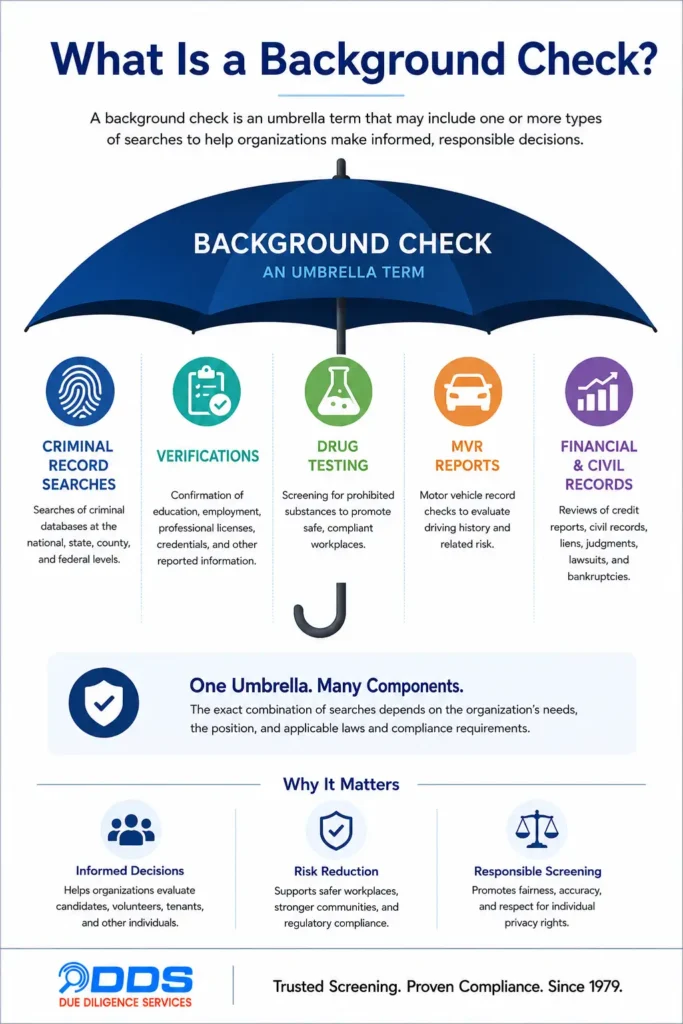
A background check is the process of verifying a person’s history and credentials before — or sometimes during — employment. But here’s the key thing most people miss: “background check” is not one service. It’s a generic description that covers many different searches, each looking at a different part of a person’s history.
When someone says “run a background check,” they could mean a criminal records search, an employment verification, a drug test, a driving record check, a credit report, or any combination of dozens of individual services. The phrase “background check” is the umbrella; the individual searches are what actually get done.
This is why understanding what a background check includes matters. Two companies can both say they “do background checks” and be doing completely different things. A thoughtful background check program selects the specific searches that fit the role, the industry, and the organization’s risk — not a generic, one-size-fits-all package.
What Does a Background Check Include?
Once you understand what is a background check at a high level, the next question is what it actually includes. The individual searches that make up a background check fall into a few broad categories. A complete background check program may use several of these, or just a few, depending on the role:
Criminal Records Searches
The most well-known component. This includes county and statewide criminal searches, federal criminal searches, the national criminal database index, and specialized registries like the sex offender registry. Criminal searches confirm whether a candidate has a relevant conviction history.
Verifications
Confirming that what a candidate told you is true — employment verification (past job titles, dates, and employers), education verification (degrees and credentials), professional license verification, and Social Security Number verification. Verifications catch résumé fraud and confirm qualifications.
Drug and Alcohol Testing
Regulated (DOT) and non-regulated drug testing, alcohol screening, and the implementation of ongoing testing programs. Drug testing protects workplace safety, especially in safety-sensitive roles.
Driving Records (MVR)
Motor vehicle records for any role involving driving — checking license status, violations, and history.
Financial and Civil Records
Credit bureau reporting for roles with financial responsibility, plus civil records searches (judgments, liens, lawsuits, bankruptcies) for fiduciary and executive positions.
No single role needs all of these. The art of a good background check is choosing the right combination.
You Don't Need Every Search — And That's the Point
DDS has an extremely diversified menu of due diligence services. But that does not mean you need all of them — or even a large percentage of them — to satisfy your employment due diligence needs. Part of understanding what is a background check is realizing you don’t need every available search.
This is one of the most common and costly misconceptions about background checks: that “more searches” automatically means “better screening.” It doesn’t. Running searches that aren’t relevant to a role wastes money, slows down hiring, and in some cases — like credit checks for roles without financial responsibility — can create legal exposure rather than reduce it.
A well-designed background check matches the searches to the role. A cash-handling position warrants different searches than a remote software developer. A commercial driver needs an MVR and DOT drug testing that an office administrator doesn’t. The goal is a comprehensive and compliant program that uses the specific services needed to protect your company and achieve your goals — nothing more, nothing less.
DDS is here to strategically develop that program with you, selecting exactly what you need and why.
Not sure which searches your roles actually need?
A 20-minute consultation will help you understand exactly what a background check should include for your specific roles — and what it shouldn’t. DDS designs the program around your needs, not a generic package. No obligation, no charge.
How DDS Builds Your Background Check
Knowing what is a background check is one thing; building the right one is another. DDS uses a proven 3-step program to determine exactly what you need and why. This method has worked for DDS and its clients for decades:
Step 1 — Understand Your Business and Roles. DDS reviews your business, your roles, and your current screening process (if you have one). Different roles carry different risks, and the screening should reflect that.
Step 2 — Design the Right Program. Based on the role requirements, industry regulations, and your goals, DDS designs a background check program that uses the specific searches needed — compliant, comprehensive, and matched to your actual risk. If you’re starting from scratch, DDS builds the program from the ground up.
Step 3 — Implement and Support. DDS implements the program, delivers compliant reports, and provides ongoing support — with a live human being who answers the phone when you call.
Although DDS is a pioneer in the employment due diligence industry — operating since 1979 and a founding member of the industry’s professional association — it continues to evolve with the times to ensure clients receive the best protection available throughout the pre- and post-hiring due diligence process.
Background Checks and Compliance
Every background check is governed by law — most importantly the Fair Credit Reporting Act (FCRA), along with a growing set of state and local regulations. Compliance is a core part of what is a background check done correctly. Every background check is governed by law
A compliant background check requires candidate authorization before screening, proper disclosure, accurate reporting, and a specific adverse action process if the results influence a hiring decision. Certain searches — like credit checks — carry additional requirements, including separate authorization and job-relevance standards.
DDS conducts every background check as an FCRA-compliant Consumer Reporting Agency. Every report passes through compliance review before delivery, removing non-reportable information and confirming accuracy, and adverse action letter templates are provided where applicable. Because the regulations continue to evolve, DDS keeps its practices current with the changing legal landscape — so your background check program stays compliant as the rules change.
Why DDS for Your Background Checks
1. We explain, not just sell. DDS helps you understand what a background check should include for your roles — and designs the program around your actual needs.
2. A diversified menu, applied selectively.* Criminal, verifications, drug testing, MVR, credit, civil — the full range, applied only where it’s relevant to the role.
3. Compliant by design. Every background check is conducted as an FCRA-compliant CRA with compliance review before delivery.
4. Source-direct accuracy. DDS goes to the source court records and original sources rather than reselling stale database data.
5. A live human being. When you call DDS, a real support team member answers — not a phone tree.
6. Operating since 1979. A pioneer and founding member of the industry’s professional association, evolving with the times for over four decades.
Frequently Asked Questions
What is a background check?
A background check is the process of verifying a person’s history and credentials before or during employment. It’s an umbrella term — “background check” isn’t a single service but a generic description covering many individual searches, such as criminal records, employment and education verifications, drug testing, driving records, and credit reports. A background check program selects the specific searches relevant to a given role.
What does a background check include?
A background check can include criminal records searches (county, statewide, federal, sex offender registry), verifications (employment, education, professional license, SSN), drug and alcohol testing, driving records (MVR), and financial and civil records. No single role needs all of these — the right combination depends on the role, industry, and risk.
Do I need every type of search?
No. Running searches that aren’t relevant to a role wastes money, slows hiring, and can even create legal exposure. A well-designed background check matches the searches to the role — a cash-handling position needs different searches than a remote developer. DDS designs the program to use only what’s needed.
What Is a Pre-Employment Background Check?
How long does a background check take?
It depends on the searches involved. Across all DDS services, 85% of orders complete within 24 hours, though components that depend on third-party response — like direct county court searches or employment verifications — can take longer. DDS sets accurate expectations for each search.
Is a background check legal?
Yes, when conducted properly. Background checks are governed by the Fair Credit Reporting Act (FCRA) and state and local laws, which require candidate authorization, proper disclosure, accurate reporting, and a specific adverse action process. DDS conducts every background check as an FCRA-compliant Consumer Reporting Agency.
What's the difference between a background check and a criminal records check?
A criminal records check is one component of a background check. “Background check” is the umbrella term covering many searches; a criminal records check is the specific search of court records for conviction history. A background check may include a criminal records check along with verifications, drug testing, and other searches.DDS searches the official national and state registries directly, so the data reflects what those authorities have published at the time of the search. Registries are maintained and updated by their issuing government authorities; DDS accesses them at the source rather than relying on a potentially stale third-party copy.
How much does a background check cost?
Cost depends on which searches are included — a single criminal search costs less than a comprehensive multi-component program. Because DDS designs the program to use only the searches a role needs, you don’t pay for irrelevant searches. DDS has no setup fees and no minimums. A consultation provides accurate pricing for your specific needs.
How do I start a background check program?
DDS uses a proven 3-step process: understanding your business and roles, designing the right program for your needs, and implementing it with ongoing support. A free consultation is the starting point — DDS helps you determine exactly which searches your roles require and builds a compliant program around them.
Now You Know What Is a Background Check — Build the Right One
Now that you know what a background check really is, the next step is designing one that fits your roles. A free consultation shows you exactly which searches you need — and which you don’t. No obligation, no charge.